
Degrees Are Losing Value? Here’s What Companies Want Now
Introduction
For decades, a college degree was considered one of the strongest indicators of career readiness. Students were encouraged to earn a degree, add it to their resume, and use it as a gateway to professional opportunities.
But the modern job market is changing.
As technology evolves and businesses face new challenges, employers are increasingly looking beyond academic qualifications when evaluating candidates. A degree can demonstrate dedication, subject knowledge, and the ability to complete a structured program, but it does not always prove that a candidate can perform the practical responsibilities of a job.
This shift has created a growing conversation around skills over degrees.
The idea behind skills over degrees does not mean that education is no longer valuable. Degrees remain essential for many professions, including medicine, law, engineering, and other regulated careers. However, in many industries, employers are increasingly interested in what candidates can actually do rather than relying only on where they studied or what qualification they hold.
This is why understanding what companies look for beyond a degree has become increasingly important for students, fresh graduates, career changers, and experienced professionals.
Today, companies may evaluate practical experience, technical abilities, communication, problem-solving, adaptability, digital literacy, and other job-ready skills before making a hiring decision.
The result is a changing recruitment landscape where candidates who can demonstrate their capabilities may have opportunities to compete with applicants who have stronger academic credentials.
This article explores the growing importance of skills over degrees, the reasons behind this shift, and the capabilities companies increasingly want from candidates.
Table of Contents
- Why the Value of Degrees Is Being Questioned
- What Does Skills Over Degrees Really Mean?
- Are Degrees Becoming Irrelevant?
- Why Companies Are Focusing More on Skills
- What Companies Look for Beyond a Degree
- Practical Experience and Real-World Exposure
- Technical and Industry-Specific Skills
- Digital Literacy in the Modern Workplace
- Communication Skills
- Problem-Solving and Critical Thinking
- Adaptability and Willingness to Learn
- Creativity and Innovation
- Teamwork and Collaboration
- Emotional Intelligence and Professionalism
- Job-Ready Skills and Employability
- The Importance of Portfolios and Personal Projects
- Certifications and Online Learning
- The Role of Internships and Freelancing
- How Recruiters Evaluate Skills
- Why Experience Alone Is Not Enough
- How Freshers Can Compete Without Extensive Experience
- How Candidates Can Build a Skills-First Resume
- The Future of Skills-Based Hiring
- How Companies Can Build Better Hiring Strategies
- Conclusion
Why the Value of Degrees Is Being Questioned
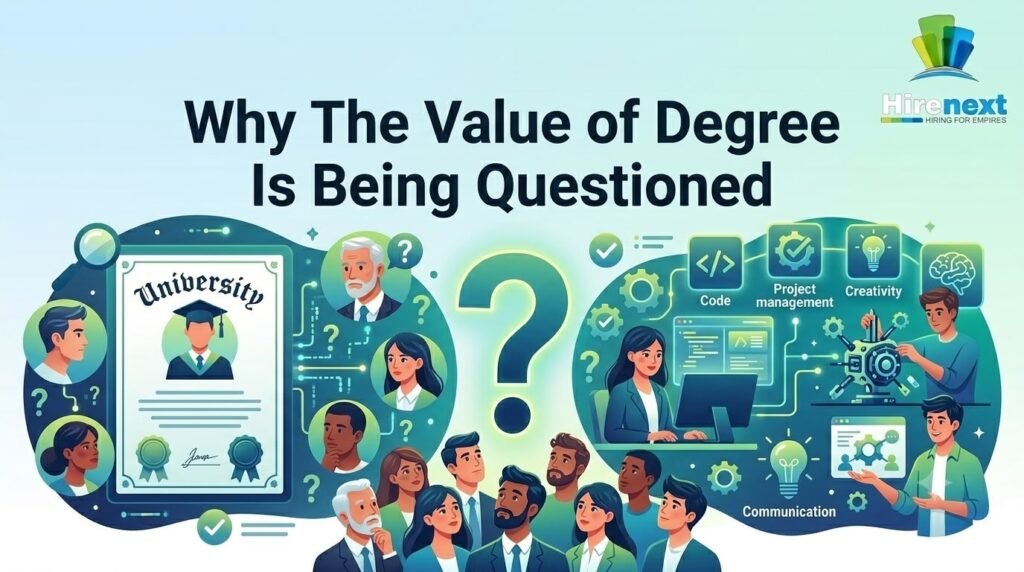
A degree remains an important achievement, but employers are increasingly recognizing that academic qualifications do not always provide a complete picture of a candidate’s capabilities.
A graduate may have excellent academic results but limited experience applying knowledge in a real workplace.
Another candidate may have fewer formal qualifications but possess:
- Strong technical abilities
- Practical experience
- A professional portfolio
- Industry certifications
- Excellent communication
- Problem-solving capabilities
This has encouraged companies to consider skills over degrees for certain roles.
The shift is particularly visible in industries such as:
- Digital marketing
- Technology
- Design
- Sales
- Content creation
- Social media
- Customer service
- E-commerce
In these fields, practical skills can often be demonstrated through projects, portfolios, certifications, internships, or previous work.
This does not mean companies have stopped valuing education.
Instead, the hiring conversation is becoming broader.
Rather than asking only:
“What degree does this candidate have?”
Employers are increasingly asking:
“What can this candidate actually do?”
What Does Skills Over Degrees Really Mean?
The concept of skills over degrees means that a candidate’s capabilities and practical knowledge may sometimes be more important than their academic qualification.
For example, imagine a company hiring a content writer.
Candidate A has a degree in English but has never written professionally.
Candidate B has a different academic background but has:
- Written blogs for businesses
- Created SEO content
- Built a writing portfolio
- Understands keyword research
- Has experience using WordPress
Depending on the role, Candidate B may be better prepared to contribute immediately.
This is the core idea behind skills over degrees.
However, this approach does not mean employers should completely ignore education.
Instead, companies should consider education as one part of a candidate’s overall profile.
The ideal evaluation may include:
- Education
- Skills
- Experience
- Portfolio
- Certifications
- Communication
- Problem-solving
- Potential
This broader approach can help companies identify candidates based on their actual ability to perform.
Are Degrees Becoming Irrelevant?
No.
Degrees are not becoming irrelevant, but their role in recruitment is changing.
For certain careers, formal education remains essential.
For example:
- Doctors require medical qualifications.
- Lawyers require legal education.
- Architects require specific professional qualifications.
- Engineers may need recognized degrees for certain positions.
However, many other roles do not require a specific degree to demonstrate competence.
A candidate applying for a digital marketing position, for example, may be evaluated based on their knowledge of:
- SEO
- Google Ads
- Social media
- Content marketing
- Analytics
In such situations, the ability to demonstrate practical job-ready skills may carry significant weight.
Therefore, the future is not necessarily about degrees versus skills.
It is about combining education with practical capability.
Why Companies Are Focusing More on Skills
Several factors are contributing to the growth of skills over degrees hiring.
Rapid Technology Changes
Technology evolves faster than traditional academic programs.
A degree completed several years ago may not cover the latest tools and platforms used by businesses today.
Companies therefore need candidates who can continuously learn.
Skills Gaps
Many businesses struggle to find candidates with the specific capabilities required for modern jobs.
A candidate with a degree but outdated knowledge may require significant training.
Increasing Importance of Digital Work
Digital tools now influence almost every industry.
Employers need people who can confidently work with technology.
Changing Career Paths
Professionals increasingly move between industries and career fields.
A candidate’s previous degree may not always match their current career direction.
Practical skills can help demonstrate transferable ability skills over degrees.
What Companies Look for Beyond a Degree
Understanding what companies look for beyond a degree can help candidates prepare for today’s recruitment environment skills over degrees.
Employers increasingly evaluate:
Technical Skills
Can the candidate perform the practical responsibilities of the role?
Communication
Can they explain ideas clearly?
Problem-Solving
Can they handle challenges independently?
Adaptability
Can they learn new tools and processes?
Teamwork
Can they collaborate effectively?
Professionalism
Can they behave responsibly in a workplace?
Initiative
Do they take ownership of their work?
These qualities collectively demonstrate whether a candidate has the job-ready skills needed to succeed.
Practical Experience and Real-World Exposure
One of the strongest arguments for skills over degrees is the importance of practical experience.
Employers want candidates who understand how to apply knowledge skills over degrees.
Practical experience can come from:
- Internships
- Freelancing
- Part-time work
- Volunteer projects
- Academic projects
- Personal projects
- Apprenticeships
For example, a digital marketing graduate who has managed social media campaigns and created SEO content may be more prepared for a marketing position than someone with only theoretical knowledge.
Experience allows candidates to demonstrate:
- Execution
- Problem-solving
- Time management
- Client communication
- Accountability
These are valuable job-ready skills that employers can use to assess potential performance.
Technical and Industry-Specific Skills
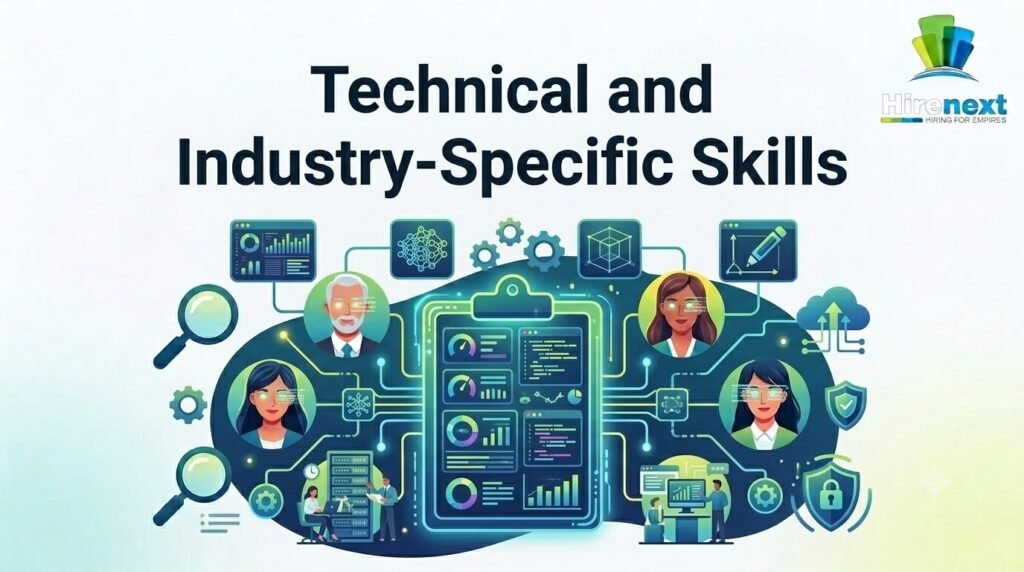
Technical expertise remains one of the most important factors companies consider skills over degrees.
The required skills depend on the role.
For example:
Digital Marketing
- SEO
- SEM
- Google Ads
- Meta Ads
- Content marketing
- Analytics
Graphic Design
- Adobe Creative Suite
- Canva
- Typography
- Branding
- Visual communication
Finance
- Excel
- Financial analysis
- Accounting software
- Reporting
Technology
- Programming
- Data analysis
- Cloud computing
- Cybersecurity
Candidates who demonstrate relevant skills can make their applications stronger.
This is why skills over degrees is becoming increasingly relevant in skills-driven industries skills over degrees.
Digital Literacy in the Modern Workplace
Digital literacy is now a fundamental part of professional life.
Employees may need to use:
- Collaboration platforms
- Cloud software
- Data tools
- CRM systems
- Project management platforms
- Artificial intelligence tools
Companies increasingly value candidates who can adapt to new technologies.
A candidate does not need to know every software platform.
However, they should demonstrate the ability to learn and use digital tools confidently.
Digital literacy is therefore one of the most valuable forms of job-ready skills today.
Communication Skills
Technical knowledge alone does not guarantee workplace success.
Employees need to communicate with:
- Managers
- Colleagues
- Customers
- Clients
- Partners
Strong communication includes:
- Clear speaking
- Professional writing
- Active listening
- Presentation skills
- Asking relevant questions
A candidate who can communicate effectively may contribute more efficiently to a team skills over degrees.
This is one reason employers evaluating what companies look for beyond a degree often consider communication a core requirement.
Problem-Solving and Critical Thinking
Every workplace faces challenges.
Companies value employees who can:
- Understand a problem
- Analyze possible causes
- Consider different solutions
- Take appropriate action
Candidates can demonstrate these abilities through real examples skills over degrees.
For example, a candidate might explain how they:
- Solved a customer complaint
- Improved a process
- Fixed a campaign problem
- Managed a project challenge
Practical examples provide evidence of job-ready skills that academic qualifications alone cannot always demonstrate.
Adaptability and Willingness to Learn
The modern workplace changes continuously.
Employees may need to learn:
- New software
- New processes
- New responsibilities
- New industry trends
Companies therefore value candidates who demonstrate adaptability skills over degrees.
A candidate who says:
“I don’t know this yet, but I can learn it”
may sometimes be more valuable than someone who knows one specific tool but refuses to adapt.
This is a major reason behind the growing focus on skills over degrees.
Creativity and Innovation
Companies need employees who can think beyond standard solutions.
Creativity can help organizations:
- Develop new products
- Improve customer experiences
- Create marketing campaigns
- Solve complex problems
Creative thinking is particularly important in fields such as:
- Marketing
- Advertising
- Design
- Product development
- Content
Candidates can demonstrate creativity through portfolios and practical projects.
Teamwork and Collaboration
Most professional roles require collaboration.
Employees need to work with people who have different:
- Skills
- Personalities
- Perspectives
- Responsibilities
Strong teamwork involves:
- Respect
- Communication
- Accountability
- Cooperation
These qualities can be difficult to measure through degrees or academic marks.
Therefore, companies increasingly consider interpersonal job-ready skills during recruitment.
Emotional Intelligence and Professionalism
Technical abilities are important, but employers also want people who can work effectively with others.
This is where emotional intelligence and professionalism become important.
Emotional intelligence includes the ability to:
- Understand your own emotions
- Manage stress
- Respond positively to feedback
- Understand other people’s perspectives
- Handle workplace conflicts
Professionalism includes:
- Punctuality
- Accountability
- Respectful communication
- Meeting deadlines
- Taking responsibility for mistakes
These qualities are difficult to measure through academic qualifications alone.
A candidate with strong technical skills but poor professionalism may struggle to succeed in a team environment.
Therefore, companies considering what companies look for beyond a degree often evaluate both technical and interpersonal capabilities.
Job-Ready Skills and Employability
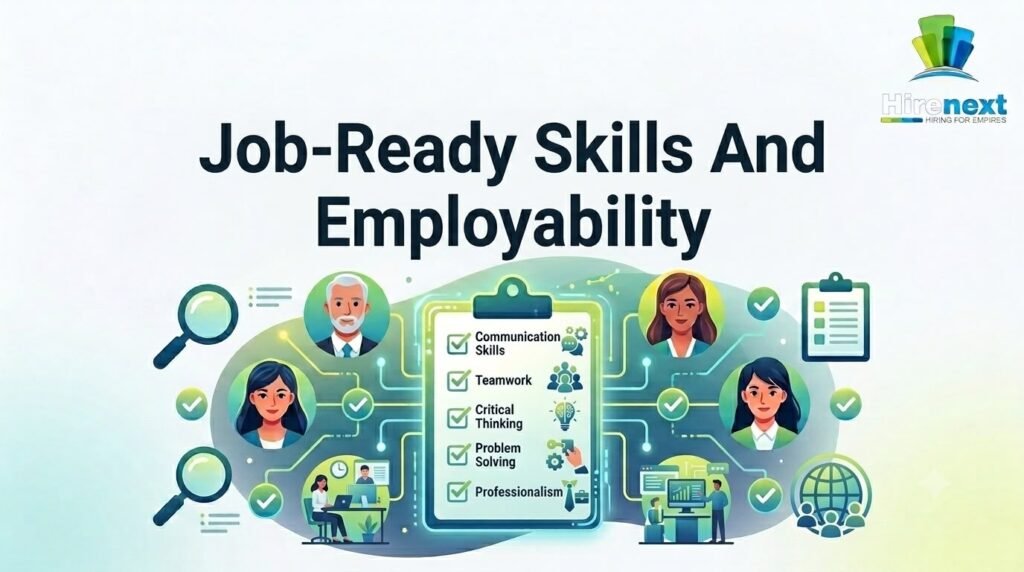
The concept of job-ready skills has become increasingly important in modern recruitment.
Being job ready means having the knowledge and practical abilities required to contribute effectively in a professional environment.
Common job-ready skills include:
- Communication
- Problem-solving
- Digital literacy
- Teamwork
- Time management
- Adaptability
- Critical thinking
- Technical expertise
The exact skills required depend on the position.
For example, a graphic designer may need proficiency in design software, while an accountant may need financial analysis and accounting software skills.
Employability is therefore influenced by both technical and transferable abilities.
This is why the skills over degrees approach is gaining attention. Employers want candidates who can demonstrate that they are prepared to perform the actual responsibilities of the role.
The Importance of Portfolios and Personal Projects
A portfolio can be one of the most powerful tools for demonstrating skills over degrees.
A resume tells employers what you claim to know.
A portfolio shows what you can actually do.
Portfolios are especially valuable in fields such as:
- Graphic design
- Content writing
- Digital marketing
- Photography
- Fashion
- Web development
- UI/UX design
For example, a digital marketing candidate could create a portfolio containing:
- SEO projects
- Social media campaigns
- Content samples
- Website audits
- Advertising examples
Similarly, a designer could showcase:
- Branding projects
- Social media creatives
- Logos
- Website designs
Personal projects are also valuable for candidates without professional experience.
They demonstrate initiative and practical application of knowledge.
This makes portfolios particularly important for fresh graduates and career changers who want to demonstrate what companies look for beyond a degree.
Certifications and Online Learning
Online education has made it easier for professionals to develop specialized skills.
Candidates can now learn through:
- Online courses
- Professional certifications
- Workshops
- Webinars
- Industry communities
Certifications can help candidates demonstrate knowledge in specific areas.
For example:
- SEO certifications
- Google Ads certifications
- Data analytics certifications
- Project management certifications
- Cloud technology certifications
However, certifications alone do not guarantee employment.
Their value increases when candidates can demonstrate how they applied the knowledge.
A candidate who has completed an SEO course and successfully improved a website’s search visibility can provide stronger evidence of job-ready skills than someone who simply lists an SEO certificate.
The Role of Internships and Freelancing
Internships and freelancing can help bridge the gap between education and employment.
Internships provide exposure to:
- Workplace culture
- Team collaboration
- Professional communication
- Deadlines
- Real projects
Freelancing can provide similar benefits.
A freelancer may learn how to:
- Communicate with clients
- Manage projects
- Negotiate requirements
- Deliver work on time
- Solve unexpected problems
These experiences can help candidates develop practical job-ready skills.
For employers, candidates with real-world exposure may require less initial training.
This is another reason companies are increasingly considering skills over degrees when evaluating candidates.
How Recruiters Evaluate Skills
Recruiters are increasingly using multiple methods to evaluate candidates.
Instead of relying solely on resumes, companies may use:
Skills Assessments
Candidates complete practical tests related to the job.
Work Samples
Applicants submit examples of previous work.
Structured Interviews
Recruiters ask consistent questions designed to evaluate specific competencies.
Behavioral Questions
Candidates explain how they handled real situations in the past.
Portfolio Reviews
Recruiters evaluate practical work and achievements.
These methods allow companies to understand what companies look for beyond a degree.
They also help identify candidates who may not have traditional educational backgrounds but possess strong capabilities.
Why Experience Alone Is Not Enough
While experience is valuable, it should not be the only hiring factor.
A candidate with many years of experience may still lack:
- Current technical knowledge
- Adaptability
- Digital skills
- Communication
- Willingness to learn
Meanwhile, a candidate with less experience may have recently developed relevant skills and demonstrate strong potential.
This is why companies should evaluate both experience and capability.
The goal of skills over degrees is not to replace one rigid hiring requirement with another.
Instead, it encourages organizations to consider the complete candidate profile.
How Freshers Can Compete Without Extensive Experience
Fresh graduates often worry that they cannot compete with experienced professionals.
However, freshers can demonstrate job-ready skills in several ways.
Build Personal Projects
Create projects related to your desired career.
Complete Internships
Gain exposure to real workplace environments.
Create a Portfolio
Show employers evidence of what you can do.
Earn Relevant Certifications
Choose certifications aligned with your target role.
Improve Communication
Practice interviews, presentations, and professional writing.
Use LinkedIn Professionally
Share projects, achievements, and industry insights.
Learn Industry Tools
Develop practical knowledge of software and platforms used in your target industry.
Freshers who actively develop these capabilities can demonstrate potential even without years of experience.
How Candidates Can Build a Skills-First Resume
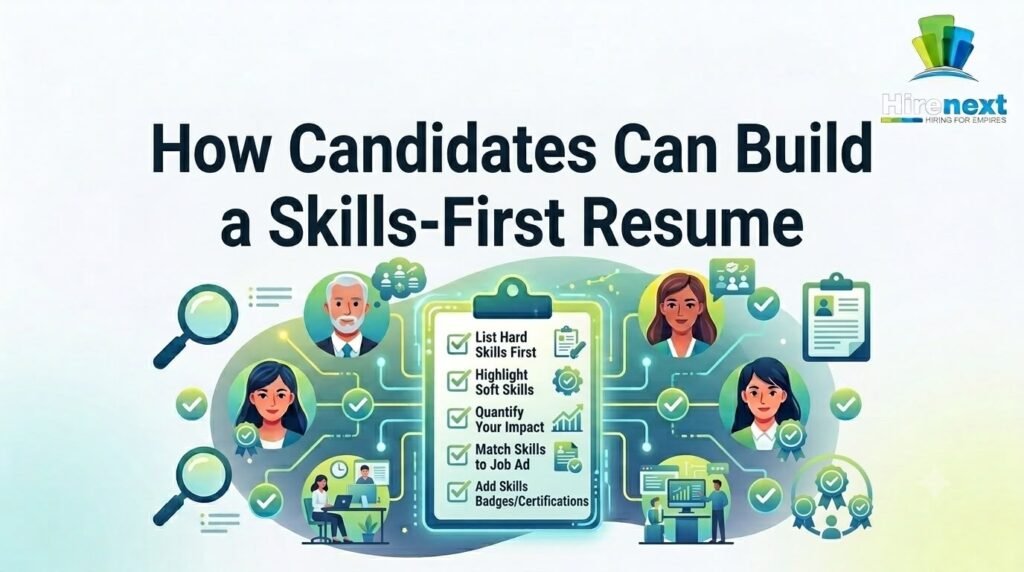
A skills-first resume focuses on what a candidate can contribute rather than simply listing educational qualifications.
Candidates should:
Highlight Relevant Skills
Mention skills directly connected to the job.
Add Practical Projects
Describe what you created or achieved.
Include Certifications
List relevant professional training.
Quantify Achievements
Use numbers wherever possible.
Instead of writing:
“Managed social media.”
Write:
“Created and managed social media content that increased engagement by 30%.”
Specific results make skills more credible.
Customize the Resume
Candidates should adjust their resume for each role.
Understanding what companies look for beyond a degree allows job seekers to present their experience more strategically.
The Future of Skills-Based Hiring
The shift toward skills over degrees is likely to continue as businesses adapt to changing technology and workforce requirements.
Several trends are influencing the future of recruitment.
Skills-Based Job Descriptions
Companies may increasingly focus job descriptions on actual capabilities rather than unnecessary degree requirements.
Digital Assessments
Candidates may be evaluated through practical tests and simulations.
AI-Assisted Recruitment
Technology may help recruiters identify candidates based on skills and experience.
Portfolio-Based Hiring
Candidates may increasingly demonstrate their capabilities through real work samples.
Continuous Learning
Employers may value candidates who regularly update their skills.
The future of hiring may therefore become more focused on what people can do rather than simply what qualifications they hold.
How Companies Can Build Better Hiring Strategies
If businesses want to benefit from skills-based recruitment, they need to rethink how they evaluate candidates.
Remove Unnecessary Degree Requirements
Companies should ask whether a degree is genuinely necessary for the position.
For some roles, it may be essential.
For others, practical skills may be more relevant.
Define Required Skills Clearly
Hiring managers should identify:
- Essential skills
- Preferred skills
- Transferable abilities
- Skills that can be learned after joining
Use Practical Assessments
Skills tests and work samples can provide valuable evidence.
Focus on Potential
Candidates should be evaluated based on their ability to learn and grow.
Train Hiring Managers
Recruiters and managers should be aware of unconscious bias related to educational backgrounds.
These strategies can help companies build more inclusive and effective recruitment processes.
Skills Over Degrees: What Should Candidates Focus On?
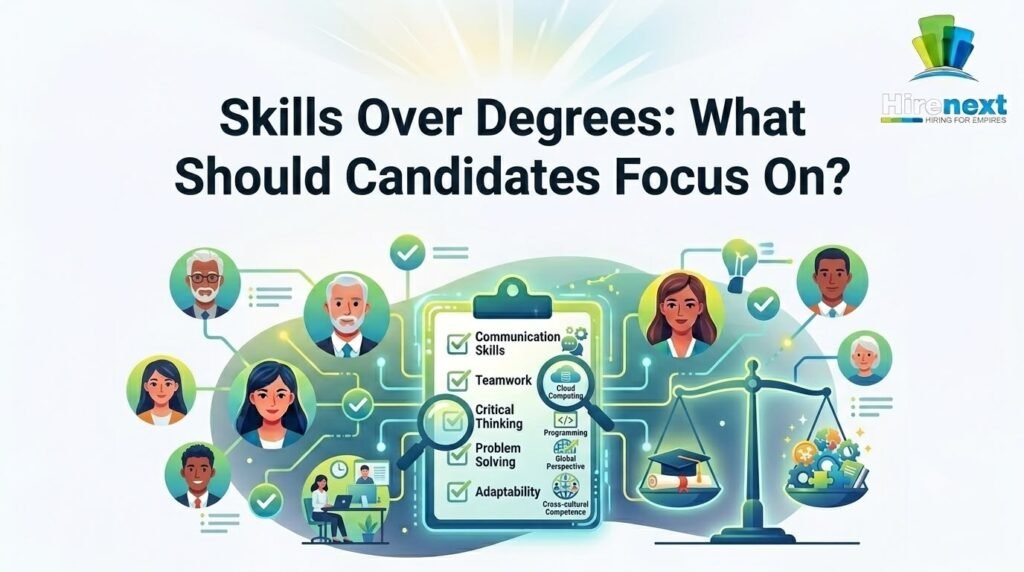
Candidates should not assume that degrees no longer matter.
Instead, they should focus on combining education with practical capability.
A strong professional profile may include:
- A relevant degree
- Industry certifications
- Practical experience
- Technical skills
- Soft skills
- A portfolio
- Personal projects
- Continuous learning
This combination can make candidates more competitive.
For students and freshers, the message is simple:
Do not wait until graduation to become job ready.
Start developing relevant skills while studying.
For experienced professionals, the focus should be on staying current and continuously improving.
What Companies Look for Beyond a Degree: The Complete Picture
Understanding what companies look for beyond a degree is essential for anyone entering today’s workforce.
Employers increasingly want candidates who can:
- Perform practical tasks
- Solve problems
- Communicate clearly
- Work with teams
- Adapt to change
- Learn continuously
- Use technology
- Take initiative
A degree can demonstrate that someone has completed an educational journey.
Skills demonstrate what they can contribute.
The strongest candidates are those who can provide evidence of both knowledge and capability.
Are Skills More Important Than Degrees?
The answer depends on the role.
For regulated professions, formal qualifications remain essential.
For many other careers, employers may place greater emphasis on demonstrated skills and experience.
Therefore, the future should not be viewed as:
Degrees vs. Skills
Instead, it should be:
Education + Skills + Experience
This combination provides candidates with a stronger foundation for long-term career success.
Conclusion
The growing conversation around skills over degrees reflects a major change in how companies evaluate talent.
Degrees continue to have value and remain essential for many professions. However, in a rapidly changing job market, academic qualifications alone may not always demonstrate whether someone is ready to perform a specific role.
This is why understanding what companies look for beyond a degree has become increasingly important.
Employers are looking for candidates with practical experience, technical expertise, communication, adaptability, problem-solving abilities, digital literacy, and other job-ready skills.
Candidates can demonstrate these capabilities through internships, freelance projects, personal projects, portfolios, certifications, and real-world experience.
For companies, a skills-based approach can help expand talent pools and identify capable professionals who may otherwise be overlooked because of traditional degree requirements.
For candidates, the message is equally important: education still matters, but what you can actually do matters too.
The future of recruitment is unlikely to be completely degree-free. Instead, it will increasingly focus on a more complete picture of talent—one that considers education, practical skills, experience, potential, and the ability to keep learning.
Ultimately, the rise of skills over degrees is not about making degrees worthless.
It is about recognizing that a qualification is only one part of a person’s professional potential.
The candidates who combine education with relevant job-ready skills will be better prepared to stand out, adapt to changing workplaces, and build successful careers in the future.