
Why Hiring Fast Is Not the Same as Hiring Smart
- July 27, 2026
- Posted by: Hirenext
- Category: Uncategorized

Introduction
In today’s competitive business environment, companies often feel pressure to fill open positions as quickly as possible. An employee leaves, a new project starts, or business growth creates an urgent staffing need. As a result, hiring managers may focus heavily on reducing the time it takes to recruit and onboard someone.
However, speed should not be confused with effectiveness.
The debate around fast hiring vs smart hiring has become increasingly important for businesses of all sizes. While hiring quickly can help organizations avoid productivity gaps, making a rushed decision can also lead to poor performance, employee turnover, and increased recruitment costs.
Smart hiring focuses on finding the right candidate for the right role while maintaining an efficient recruitment timeline.
The goal is not to choose between speed and quality. Instead, companies should learn how to combine both.
Understanding fast hiring vs smart hiring can help organizations build recruitment strategies that reduce unnecessary delays without compromising the quality of hire.
This article explores why hiring quickly is not always the same as hiring effectively and explains how to hire the right candidate quickly without sacrificing long-term business outcomes.
Table of Contents
- What Is Fast Hiring?
- What Is Smart Hiring?
- Fast Hiring vs Smart Hiring: Understanding the Difference
- Why Companies Feel Pressure to Hire Quickly
- The Hidden Risks of Hiring Too Fast
- How Speed Can Affect Quality of Hire
- The Cost of a Bad Hiring Decision
- When Fast Hiring Makes Sense
- Why Smart Hiring Takes a Strategic Approach
- How to Hire the Right Candidate Quickly
- Define the Role Before Starting Recruitment
- Build a Strong Candidate Pipeline
- Use Structured Screening
- Improve Interview Efficiency
- Use Recruitment Technology
- Partner With Recruitment Agencies
- Measuring Quality of Hire
- Speed vs Quality: Finding the Right Balance
- Common Hiring Mistakes Companies Should Avoid
- Creating a Faster and Smarter Hiring Process
- How Smart Hiring Supports Long-Term Growth
- Conclusion
What Is Fast Hiring?
Fast hiring refers to the process of filling a vacant position within a short period.
Companies may prioritize fast hiring when:
- A critical employee leaves unexpectedly
- A new project requires immediate staffing
- Business demand increases
- The organization is expanding rapidly
- Existing employees are overloaded
Speed can be valuable.
An open position can create additional pressure on existing employees and reduce productivity. In customer-facing roles, staff shortages may even affect service quality.
However, fast hiring becomes problematic when companies prioritize speed at the expense of candidate evaluation.
This is where the difference between fast hiring vs smart hiring becomes clear.
Fast hiring asks:
“How quickly can we fill this position?”
Smart hiring asks:
“How quickly can we find someone who is genuinely suitable for this position?”
The second question is more valuable for long-term business success.
What Is Smart Hiring?
Smart hiring is a strategic approach that balances recruitment speed with candidate quality.
It focuses on identifying candidates based on:
- Relevant skills
- Experience
- Potential
- Communication
- Problem-solving
- Adaptability
- Cultural alignment
Smart hiring does not necessarily mean hiring slowly.
In fact, an efficient smart hiring strategy can help companies make better decisions faster.
The key difference in fast hiring vs smart hiring is the quality of the recruitment process.
A company that takes six weeks to hire someone who leaves after three months has not necessarily hired better than a company that hires a strong candidate in two weeks.
The real measure of success is the quality of hire.
Fast Hiring vs Smart Hiring: Understanding the Difference
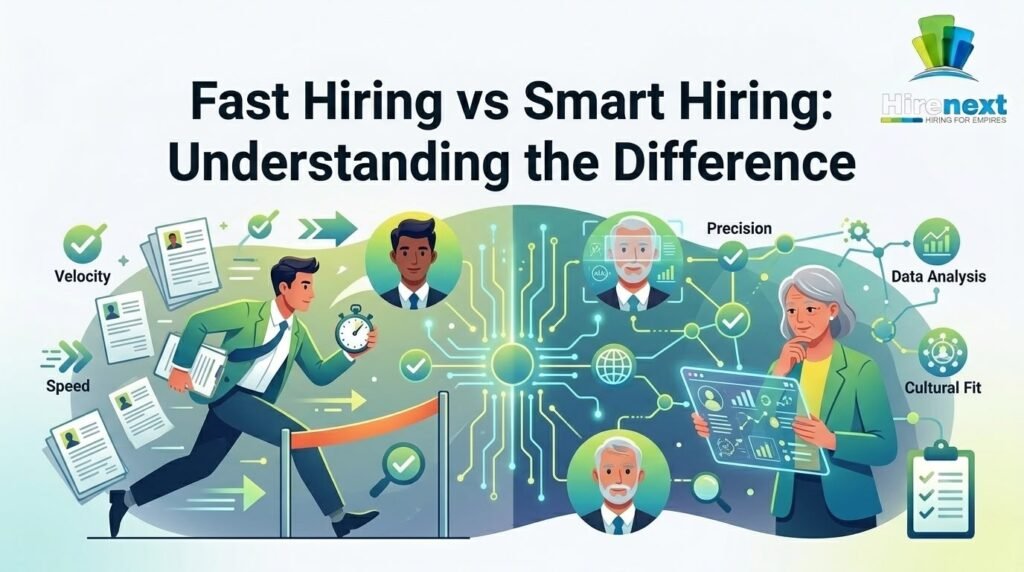
The debate between fast hiring vs smart hiring is often presented as a choice between speed and quality.
But this is not always accurate.
The real issue is whether a company has an efficient process that allows it to evaluate candidates properly.
Fast Hiring
Focuses primarily on:
- Reducing time to hire
- Filling vacancies
- Avoiding productivity gaps
- Responding to urgent business needs
Smart Hiring
Focuses on:
- Candidate suitability
- Long-term performance
- Skills and potential
- Employee retention
- Quality of hire
The ideal recruitment strategy combines the strengths of both approaches.
Companies should aim to hire quickly—but not carelessly.
Why Companies Feel Pressure to Hire Quickly
There are several reasons organizations prioritize speed.
Employee Shortages
When a position remains vacant, existing employees may need to take on additional responsibilities.
This can increase:
- Stress
- Workload
- Burnout
Business Growth
Rapidly growing companies often need employees immediately to support expansion.
Competitive Talent Markets
Strong candidates may receive multiple job offers.
A company that takes too long to make a decision may lose qualified talent.
Urgent Business Requirements
Certain roles cannot remain vacant for long.
For example, a company may urgently need sales professionals to meet revenue targets or customer service employees to manage increasing demand.
These situations demonstrate why speed matters.
However, pressure to hire quickly should not eliminate essential evaluation steps.
The Hidden Risks of Hiring Too Fast
One of the biggest problems with focusing only on fast hiring vs smart hiring is that rushed recruitment decisions can create long-term problems.
Poor Candidate Matching
A candidate may appear suitable during a brief interview but lack the skills required for the actual role.
Higher Employee Turnover
Employees who are not a good fit may leave quickly.
Increased Training Costs
Companies may need to invest additional time and resources in employees who lack essential skills.
Team Disruption
A poor hire can affect team productivity and workplace morale.
Repeated Recruitment
If the employee leaves, the company must restart the entire hiring process.
Therefore, hiring quickly can sometimes result in hiring twice.
How Speed Can Affect Quality of Hire
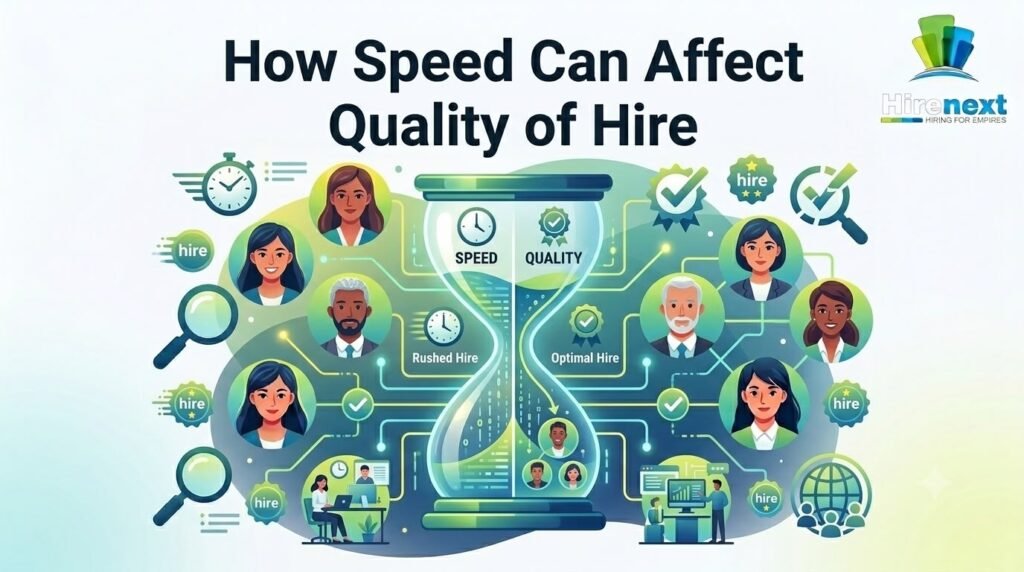
The quality of hire refers to how effectively a new employee performs and contributes to an organization.
Companies may evaluate quality of hire through:
- Job performance
- Productivity
- Employee retention
- Manager satisfaction
- Team contribution
- Achievement of goals
When companies rush recruitment, they may reduce the time available for proper evaluation.
For example, a hiring manager may:
- Skip reference checks
- Reduce interview stages
- Ignore skill gaps
- Overlook warning signs
These shortcuts can negatively affect the quality of hire.
This does not mean every fast hire is a bad hire.
Instead, it means speed should come from process efficiency rather than from removing important evaluation steps.
The Cost of a Bad Hiring Decision
A bad hire can cost a company much more than the initial recruitment expense.
Potential costs include:
- Recruitment advertising
- Interview time
- Onboarding
- Training
- Lost productivity
- Team disruption
- Employee replacement
There can also be indirect costs.
For example, if an employee performs poorly in a customer-facing role, the company may lose customer trust.
Similarly, a poor manager can affect team morale and employee retention.
This is why the fast hiring vs smart hiring discussion should always include the long-term financial impact of recruitment decisions.
Hiring quickly may save time today, but a poor decision can create much larger costs tomorrow.
When Fast Hiring Makes Sense
Fast hiring is not always a bad strategy.
There are situations where speed is essential.
For example:
Urgent Vacancies
If an important employee suddenly leaves, the company may need a replacement quickly.
Seasonal Hiring
Businesses may need additional workers during peak seasons.
High-Volume Recruitment
Companies hiring large numbers of employees may need efficient recruitment systems.
Rapid Business Expansion
Growing organizations may need to scale teams quickly.
Short-Term Projects
Temporary projects may require employees within a limited timeframe.
In these situations, businesses should focus on creating an efficient recruitment process rather than eliminating evaluation.
The objective should be:
Fast, structured, and informed hiring.
Why Smart Hiring Takes a Strategic Approach
Smart hiring begins before the job is advertised.
Companies need to understand:
- Why the position is required
- What responsibilities it includes
- Which skills are essential
- Which skills can be learned
- What success looks like
Without this clarity, companies may attract unsuitable applicants.
A strategic hiring process can help organizations:
- Reduce candidate screening time
- Improve interview quality
- Increase the quality of hire
- Reduce employee turnover
This demonstrates why fast hiring vs smart hiring should not be treated as an either-or decision.
The best organizations use strategy to make hiring both faster and smarter.
How to Hire the Right Candidate Quickly

The key to successful recruitment is not choosing between speed and quality. Businesses need to understand how to hire the right candidate quickly while maintaining an effective evaluation process.
A faster hiring process can be achieved by removing unnecessary delays rather than skipping important recruitment steps.
Companies can improve their approach by:
- Clearly defining job requirements
- Building talent pipelines
- Using structured screening
- Conducting focused interviews
- Leveraging recruitment technology
- Working with recruitment specialists
These strategies can help organizations improve the quality of hire without unnecessarily extending the recruitment timeline.
Define the Role Before Starting Recruitment
One of the easiest ways to make hiring faster is to clearly define the position before searching for candidates.
Companies should establish:
- Job responsibilities
- Required technical skills
- Preferred experience
- Salary range
- Work location
- Reporting structure
- Performance expectations
A vague job description attracts a broad range of candidates, many of whom may not be suitable.
This increases the amount of time recruiters spend screening applications.
Clear requirements make the recruitment process more efficient.
This is an important part of understanding how to hire the right candidate quickly.
Build a Strong Candidate Pipeline
Companies that wait until they have an urgent vacancy to start looking for talent may struggle to hire quickly.
Building a talent pipeline can solve this problem.
A talent pipeline includes potential candidates who may be suitable for future opportunities.
Companies can build pipelines through:
- Employee referrals
- Professional networking
- LinkedIn outreach
- Recruitment agencies
- Industry events
- Previous applicants
Having access to potential candidates allows organizations to respond faster when positions become available.
This approach supports both fast hiring vs smart hiring because companies can move quickly without compromising candidate evaluation.
Use Structured Screening
Screening is one of the most time-consuming parts of recruitment.
Companies may receive hundreds of applications for a single position.
A structured screening process can help recruiters identify suitable candidates efficiently.
Screening criteria may include:
- Relevant experience
- Technical skills
- Education
- Location
- Salary expectations
- Availability
Recruiters should establish these criteria before reviewing applications.
This reduces inconsistent decision-making and helps focus attention on candidates who meet the essential requirements.
Improve Interview Efficiency
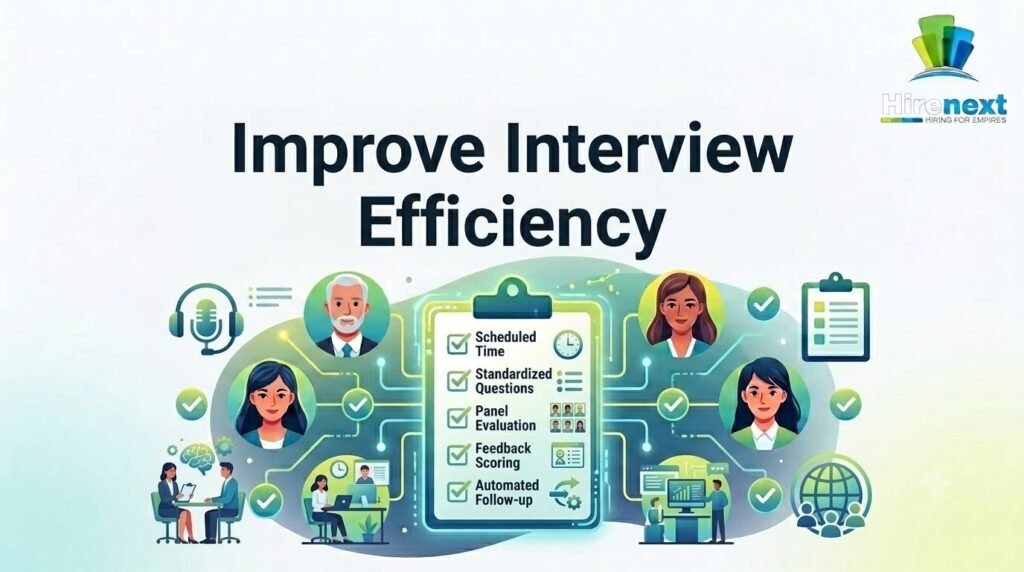
Interviews are important, but they do not need to be unnecessarily complicated.
Companies can improve interview efficiency by:
Using Structured Questions
Prepare questions that evaluate specific skills and behaviors.
Limiting Unnecessary Interview Rounds
Only include interviews that add meaningful value.
Involving the Right Decision-Makers
Ensure key stakeholders are involved early.
Setting Decision Deadlines
Avoid delaying decisions after interviews.
A structured interview process can help companies move quickly while maintaining the quality of hire.
Use Recruitment Technology
Technology can significantly improve recruitment efficiency.
Companies increasingly use:
- Applicant tracking systems
- Automated scheduling
- Digital assessments
- Resume screening tools
- Recruitment analytics
These tools can reduce administrative work.
For example, automated interview scheduling can eliminate long email exchanges between recruiters and candidates.
Applicant tracking systems can also help organizations organize candidate information.
However, technology should support human decision-making rather than replace it completely.
Recruiters still need to evaluate factors such as:
- Communication
- Motivation
- Adaptability
- Cultural alignment
The right combination of technology and human judgment can make fast hiring vs smart hiring a more balanced process.
Partner With Recruitment Agencies
Recruitment agencies can help companies hire faster while maintaining candidate quality.
Professional recruiters often have access to:
- Talent databases
- Candidate networks
- Industry knowledge
- Recruitment technology
- Experienced screening processes
This can be particularly valuable when companies need to fill positions urgently.
Recruitment agencies can help businesses with:
- Candidate sourcing
- Resume screening
- Initial interviews
- Skill evaluation
- Shortlisting
Instead of spending weeks searching for candidates, businesses can access pre-screened talent more efficiently.
For companies trying to understand how to hire the right candidate quickly, recruitment agencies can provide valuable support.
Measuring Quality of Hire
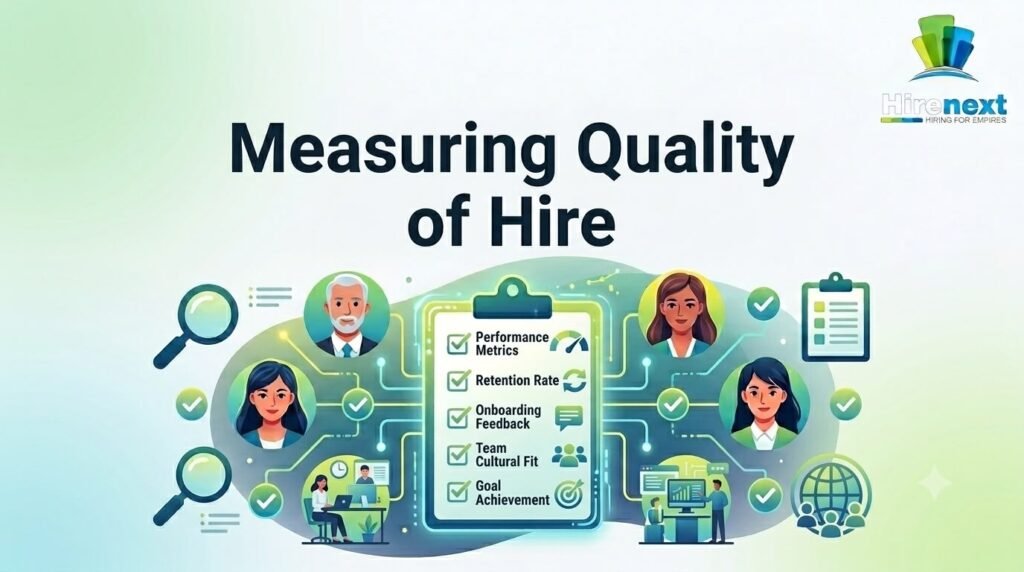
Hiring speed alone is not enough to evaluate recruitment success.
Companies should also measure quality of hire.
Important metrics may include:
Employee Retention
How long do new employees stay with the company?
Job Performance
How effectively do new hires meet their goals?
Manager Satisfaction
How satisfied are managers with new employees?
Productivity
How quickly do new employees become productive?
Employee Engagement
Are new hires engaged with their work?
Tracking these metrics helps companies understand whether their recruitment strategies are actually working.
For example, a company may reduce its time to hire by 30% but experience a significant increase in employee turnover.
This would suggest that recruitment speed improved while the quality of hire declined.
Therefore, companies should measure both speed and long-term outcomes.
Speed vs Quality: Finding the Right Balance
The debate surrounding fast hiring vs smart hiring should not be about choosing one over the other.
The ideal approach is efficient hiring.
Efficient hiring means:
Moving quickly without making careless decisions.
Companies can achieve this by:
- Preparing recruitment processes in advance
- Maintaining talent pipelines
- Using structured assessments
- Improving communication
- Setting decision timelines
This approach allows organizations to reduce unnecessary delays while protecting the quality of hire.
Common Hiring Mistakes Companies Should Avoid
Several mistakes can make recruitment both slow and ineffective.
Hiring Without Clear Requirements
Without clear criteria, recruiters may waste time reviewing unsuitable candidates.
Overcomplicating Interviews
Too many interview rounds can delay decisions.
Ignoring Candidate Communication
Poor communication can cause candidates to lose interest.
Relying Only on Resumes
Resumes cannot fully reveal a candidate’s capabilities.
Focusing Only on Speed
Hiring someone quickly does not guarantee success.
Ignoring Quality of Hire
Companies should evaluate long-term employee performance rather than only time-to-hire metrics.
Avoiding these mistakes can improve recruitment outcomes.
Creating a Faster and Smarter Hiring Process
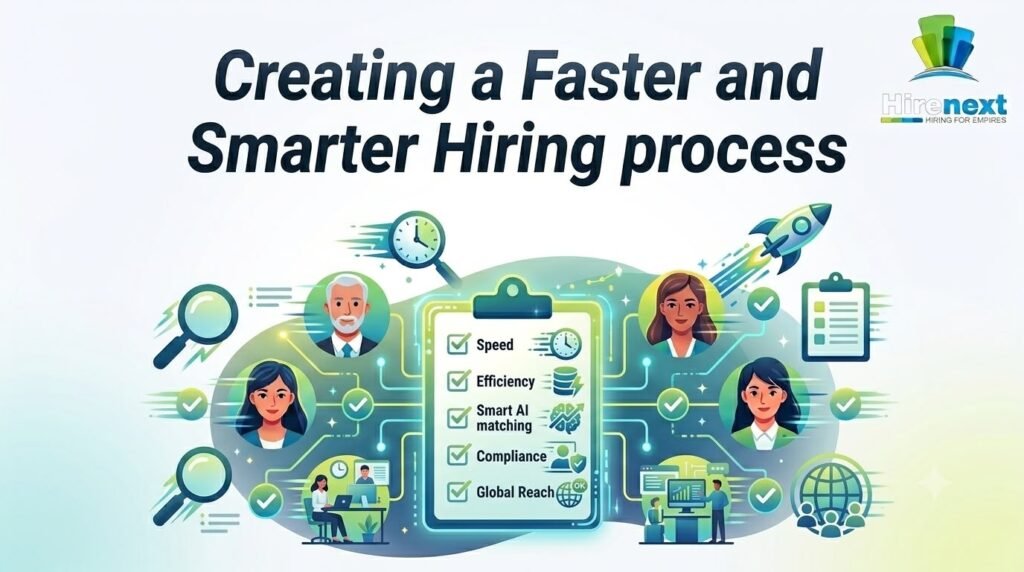
Companies can create an effective hiring process by following a systematic approach.
Step 1: Define the Position
Clearly identify responsibilities and requirements.
Step 2: Create a Talent Pipeline
Build relationships with potential candidates before vacancies arise.
Step 3: Source Candidates
Use multiple channels to reach qualified talent.
Step 4: Screen Efficiently
Use clear criteria to identify suitable candidates.
Step 5: Conduct Structured Interviews
Evaluate candidates consistently.
Step 6: Make Decisions Quickly
Set clear timelines for hiring decisions.
Step 7: Onboard Effectively
Support new employees after they join.
This process allows businesses to understand how to hire the right candidate quickly without sacrificing quality.
How Smart Hiring Supports Long-Term Growth
The impact of recruitment extends far beyond filling vacancies.
The right employees can contribute to:
- Higher productivity
- Better customer experiences
- Stronger innovation
- Improved teamwork
- Increased revenue
A strong quality of hire can therefore have a direct impact on business performance.
On the other hand, repeated hiring mistakes can create:
- High employee turnover
- Increased costs
- Poor morale
- Lost productivity
This is why organizations should focus on sustainable recruitment strategies.
The Role of Candidate Experience
Candidate experience is another important factor in the relationship between fast hiring vs smart hiring.
Candidates want recruitment processes that are:
- Clear
- Respectful
- Transparent
- Efficient
A company that takes too long to respond may lose talented candidates.
However, moving quickly does not mean ignoring candidates or rushing them through the process.
Companies should maintain regular communication and provide clear information about:
- Interview stages
- Timelines
- Job responsibilities
- Compensation
- Next steps
A positive candidate experience can help organizations attract and retain stronger talent.
Why Hiring Smart Does Not Mean Hiring Slowly
One of the biggest misconceptions in recruitment is that smart hiring requires a long hiring process.
This is not necessarily true.
A company with a well-designed recruitment system can often make better decisions faster than a company with an inefficient process.
Smart hiring is about preparation.
When organizations have:
- Clear job descriptions
- Defined evaluation criteria
- Talent pipelines
- Structured interviews
- Efficient decision-making
They can move quickly without compromising candidate quality.
Therefore, the real goal is not simply fast hiring vs smart hiring.
It is fast and smart hiring.
Conclusion
The debate between fast hiring vs smart hiring highlights an important challenge for modern businesses.
Hiring quickly can help companies fill vacancies, maintain productivity, and respond to urgent business needs. However, speed without strategy can lead to poor decisions, employee turnover, increased costs, and a lower quality of hire.
Smart hiring takes a more balanced approach.
Companies should focus on creating efficient systems that allow them to identify, evaluate, and hire suitable candidates without unnecessary delays. Clear job descriptions, structured screening, efficient interviews, recruitment technology, talent pipelines, and recruitment agencies can all help businesses achieve this balance.
Understanding how to hire the right candidate quickly is ultimately about improving the recruitment process—not simply reducing the number of days it takes to hire.
The most successful companies recognize that hiring speed is only one measure of recruitment success. The real goal is to find employees who can perform well, adapt to the organization, contribute to business objectives, and stay for the long term.
In the end, the best recruitment strategy is not about choosing between fast hiring and smart hiring.
It is about building a fast, structured, and smart hiring process that protects the quality of hire while helping businesses secure the talent they need at the right time.