
7 Interview Questions That Reveal a Candidate’s Real Personality
Hiring the right employee is about much more than checking qualifications, experience, and technical skills. A candidate may have an impressive resume and perform well in a technical test, but that does not necessarily tell an employer how they will behave in real workplace situations.
Will they take responsibility when something goes wrong? Can they handle criticism? How do they respond to pressure? Are they comfortable working with different personalities? Do they communicate honestly when facing a problem?
These questions become especially important when companies want to build reliable, collaborative, and productive teams.
This is where interview questions to assess personality become valuable. Well-designed questions can help recruiters understand how candidates think, communicate, make decisions, respond to challenges, and interact with others.
Instead of asking candidates to simply describe themselves as “hardworking” or “positive,” recruiters can use behavioral questions to encourage candidates to share examples from their actual experiences.
In this guide, we explore seven effective interview questions to assess personality, explain what each question reveals, and discuss how recruiters can use them as part of a broader soft skills assessment.
Table of Contents
- Why Personality Matters During Hiring
- What Are Personality-Based Interview Questions?
- Interview Questions to Assess Personality vs Traditional Questions
- Question 1: Tell Me About a Time You Made a Mistake at Work
- Question 2: How Do You Handle Criticism?
- Question 3: Tell Me About a Conflict With a Colleague
- Question 4: Describe a Situation Where You Had to Work Under Pressure
- Question 5: Tell Me About a Time You Had to Adapt to Change
- Question 6: What Do You Do When You Don’t Know How to Complete a Task?
- Question 7: Tell Me About a Time You Took Initiative
- What These Questions Reveal About Candidates
- Using the STAR Method to Evaluate Answers
- How to Conduct a Fair Personality Assessment
- Common Mistakes Recruiters Should Avoid
- How Personality Questions Improve Candidate Experience
- Combining Personality Questions With Skills Assessment
- Creating a Better Hiring Process
- Conclusion
Why Personality Matters During Hiring
Technical ability is important, but it is only one part of employee performance.
Two candidates may have similar qualifications and experience while behaving very differently in the workplace.
One may communicate clearly, accept feedback, take responsibility, and collaborate effectively.
Another may struggle with criticism, avoid accountability, or find it difficult to adapt to changing circumstances.
This is why interview questions to assess personality can add another layer to the recruitment process.
Personality-focused questions can help recruiters understand characteristics such as:
- Accountability
- Adaptability
- Communication
- Emotional maturity
- Teamwork
- Resilience
- Initiative
- Problem-solving
- Self-awareness
However, recruiters should remember that an interview is not a psychological diagnosis. The goal is not to label someone’s personality.
Instead, the purpose is to understand workplace behaviors that are relevant to the role.
What Are Personality-Based Interview Questions?
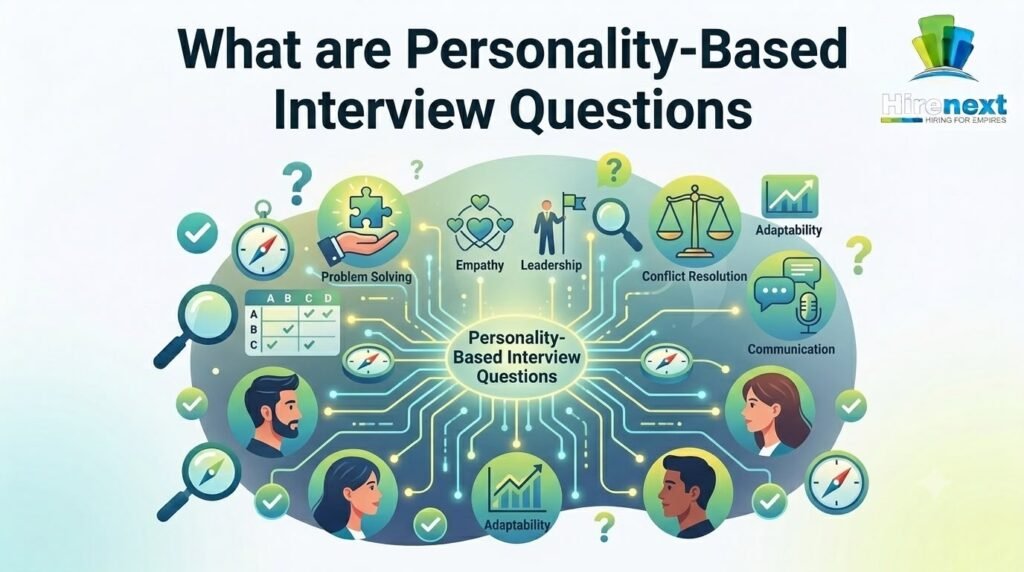
Personality-based interview questions are questions designed to understand how candidates behave in workplace situations.
Rather than asking:
“Are you good at teamwork?”
A recruiter might ask:
“Tell me about a time when you had to work with someone whose approach was very different from yours.”
The second question encourages the candidate to provide evidence.
This makes behavioral questions more useful because candidates have to explain what happened, what they did, and what happened afterward.
Effective interview questions to assess personality should therefore focus on real situations rather than vague self-descriptions.
Interview Questions to Assess Personality vs Traditional Questions
Traditional questions often include:
- “What are your strengths?”
- “Are you a team player?”
- “Are you good under pressure?”
- “Would you describe yourself as adaptable?”
The problem is that most candidates know what recruiters want to hear.
Almost anyone can say:
“I’m very adaptable.”
But a behavioral question can reveal whether that adaptability has actually been demonstrated.
For example:
“Tell me about a time your responsibilities changed unexpectedly. How did you respond?”
Now the recruiter has an opportunity to evaluate the candidate’s actual behavior.
This is why behavioral questions to ask candidates can be more informative than simple yes-or-no personality questions.
1. Tell Me About a Time You Made a Mistake at Work
Mistakes are unavoidable in professional environments.
What matters is how employees respond when something goes wrong.
This is one of the most effective interview questions to assess personality because it can reveal accountability, honesty, self-awareness, and learning ability.
What to Look For
Pay attention to whether the candidate:
- Takes responsibility
- Explains the situation honestly
- Avoids blaming others
- Describes how they corrected the problem
- Explains what they learned
A strong answer might demonstrate:
“I made an incorrect assumption, realized the problem, informed my manager, corrected it, and changed my process so it wouldn’t happen again.”
A concerning answer may involve repeatedly blaming colleagues or circumstances without acknowledging personal responsibility interview questions to assess personality.
What This Question Reveals
This question can provide insight into:
- Accountability
- Self-awareness
- Learning mindset
- Honesty
- Problem-solving
The objective isn’t to find a candidate who has never made mistakes.
It is to find someone who can learn from them.
2. How Do You Handle Criticism?
Feedback is a normal part of professional development.
Employees need to be able to receive constructive criticism without becoming defensive or disengaged.
Instead of asking whether someone “takes criticism well,” use a behavioral question.
For example:
“Tell me about a time you received feedback you initially disagreed with. What did you do?”
This is another useful example of interview questions to assess personality because it creates an opportunity to evaluate emotional maturity.
What to Look For
Listen for:
- Willingness to listen
- Ability to reflect
- Emotional control
- Openness to improvement
- Respectful communication
A strong candidate may explain that they initially disagreed but took time to understand the feedback and eventually recognized something useful in it.
What This Question Reveals
It can reveal:
- Coachability
- Self-awareness
- Emotional intelligence
- Professional maturity
Candidates don’t need to agree with every piece of feedback.
What matters is whether they can respond professionally interview questions to assess personality.
3. Tell Me About a Conflict With a Colleague
Workplace disagreements are inevitable.
Employees may disagree about deadlines, priorities, responsibilities, communication styles, or approaches to solving problems.
Rather than asking, “Do you work well with others?” recruiters can ask:
“Tell me about a time you disagreed with a colleague. How did you handle the situation?”
This is one of the most practical behavioral questions to ask candidates when assessing teamwork.
What to Look For
Look for evidence of:
- Active listening
- Respect
- Communication
- Collaboration
- Conflict resolution
- Focus on solutions
Be cautious if a candidate describes every workplace conflict as someone else’s fault.
A strong answer usually demonstrates that the candidate attempted to understand the other person’s perspective and find a practical solution.
What This Question Reveals
It can help evaluate:
- Teamwork
- Emotional intelligence
- Communication skills
- Conflict management
- Professionalism
These qualities are especially important for positions that involve frequent collaboration.
4. Describe a Situation Where You Had to Work Under Pressure
Almost every workplace has stressful periods.
Deadlines may change. Customers may complain. Projects may face unexpected problems.
A useful question is:
“Tell me about a time you had to complete an important task under significant pressure. How did you manage it?”
This type of question is valuable among interview questions to assess personality because pressure can reveal behaviors that aren’t obvious during a relaxed interview.
What to Look For
Pay attention to whether the candidate:
- Prioritized tasks
- Remained organized
- Communicated with others
- Asked for support when needed
- Maintained quality
- Managed emotions appropriately
A good answer doesn’t necessarily mean the candidate claims they were never stressed.
In fact, realistic answers often demonstrate that the person recognized pressure and used practical strategies to manage it.
What This Question Reveals
It may provide insight into:
- Resilience
- Time management
- Prioritization
- Emotional control
- Decision-making
Recruiters should evaluate pressure management according to the demands of the specific role interview questions to assess personality.
5. Tell Me About a Time You Had to Adapt to Change
Change is common in modern workplaces.
Companies introduce new technologies, restructure teams, change priorities, launch new products, and modify processes.
An effective question is:
“Tell me about a time your work changed unexpectedly. How did you adapt?”
This is one of the most important interview questions to assess personality for fast-growing organizations and startups.
What to Look For
Look for:
- Flexibility
- Curiosity
- Positive problem-solving
- Learning ability
- Willingness to adjust
A strong candidate might explain how they learned a new tool, adjusted to a new manager, changed priorities, or took on unfamiliar responsibilities.
What This Question Reveals
It can reveal:
- Adaptability
- Learning mindset
- Resilience
- Openness to change
Candidates who can adapt without losing focus can be valuable in rapidly changing environments interview questions to assess personality.
6. What Do You Do When You Don’t Know How to Complete a Task?
Nobody knows everything.
The important question is what employees do when they encounter something unfamiliar.
Ask:
“Tell me about a time you were given a task you didn’t know how to complete. What did you do?”
This question can reveal whether candidates wait passively for instructions or actively seek solutions.
What to Look For
Strong answers may include:
- Researching the problem
- Asking appropriate questions
- Consulting experienced colleagues
- Testing possible solutions
- Learning a new skill
- Taking responsibility for the outcome
What This Question Reveals
This question is particularly useful for evaluating:
- Initiative
- Resourcefulness
- Curiosity
- Independence
- Problem-solving
It can be an important component of a broader soft skills assessment.
7. Tell Me About a Time You Took Initiative
Some employees wait for instructions.
Others identify problems and take action before being asked.
To understand the difference, ask:
“Tell me about a time you noticed something that needed improvement and took action without being asked.”
This is one of the strongest interview questions to assess personality for roles where ownership is important.
What to Look For
Listen for evidence of:
- Proactivity
- Ownership
- Confidence
- Creativity
- Business awareness
The initiative doesn’t have to be dramatic.
It could involve:
- Improving a process
- Helping a colleague
- Identifying a customer issue
- Creating a more efficient system
- Suggesting a new approach
What This Question Reveals
It can help recruiters understand:
- Leadership potential
- Initiative
- Ownership
- Problem-solving
- Confidence
Employees who consistently identify interview questions to assess personality and solve problems can have a significant impact on growing businesses
What These Questions Reveal About Candidates
The seven questions above can provide insight into different workplace behaviors.
| Interview Question | Key Trait Evaluated |
|---|---|
| Mistake at work | Accountability |
| Handling criticism | Coachability |
| Conflict with a colleague | Teamwork |
| Working under pressure | Resilience |
| Adapting to change | Adaptability |
| Unknown task | Initiative |
| Taking initiative | Ownership |
Together, these questions create a stronger picture of how a candidate may behave at work.
However, recruiters should avoid making decisions based on a single answer.
Personality assessment should consider the overall pattern of behavior.
Using the STAR Method to Evaluate Answers
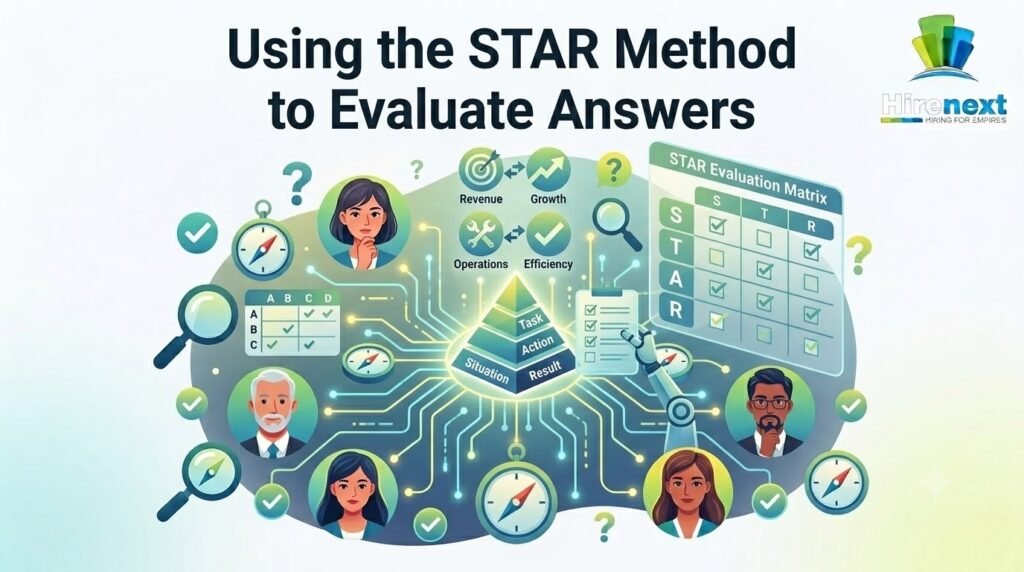
The STAR method can help recruiters structure behavioral interviews.
STAR stands for:
S — Situation
What was happening?
T — Task
What responsibility did the candidate have?
A — Action
What did the candidate personally do?
R — Result
What happened afterward?
For example, if a candidate says:
“I handled a difficult customer.”
That answer provides limited information.
A stronger response explains:
- What happened
- What responsibility they had
- What actions they took
- What the final outcome was
Recruiters can use follow-up questions such as:
- “What did you personally do?”
- “What happened next?”
- “What would you do differently?”
- “What did you learn?”
This makes behavioral questions to ask candidates significantly more effective.
How to Conduct a Fair Personality Assessment
Personality-based interviews can be useful, but recruiters need to avoid bias.
A good soft skills assessment should focus on behaviors that are genuinely relevant to the role.
For example, a recruiter shouldn’t reject a candidate simply because they are naturally quiet.
Being introverted does not automatically mean someone has poor communication skills.
Similarly, being highly outgoing doesn’t automatically mean someone is a strong team player.
Recruiters should evaluate evidence rather than personal preferences.
Use Consistent Questions
Ask candidates applying for the same position similar core questions.
Use Clear Evaluation Criteria
Decide in advance what good answers demonstrate.
Avoid Personal Questions
Focus on workplace behaviors rather than private life.
Use Multiple Evaluation Methods
Combine personality questions with:
- Skills assessments
- Work samples
- Technical interviews
- Reference checks
- Resume evaluation
This creates a more balanced hiring decision.
Common Mistakes Recruiters Should Avoid
Even good questions can produce poor hiring decisions if the interview is badly structured.
Asking Leading Questions
Questions such as “You’re comfortable working under pressure, right?” encourage socially desirable answers.
Use open-ended questions instead.
Judging Personality Too Quickly
A candidate’s interview behavior may be influenced by nervousness.
Don’t confuse interview anxiety with workplace personality.
Asking Too Many Generic Questions
Questions such as “What are your strengths?” often produce rehearsed responses.
Behavioral questions provide more useful evidence.
Ignoring the Role
Not every personality characteristic matters equally for every job.
Define which behaviors are genuinely required for success.
Letting Personal Bias Influence Decisions
Recruiters may naturally prefer candidates who communicate or behave similarly to themselves.
Structured scoring can help reduce this bias.
How Personality Questions Improve Candidate Experience
A strong interview process should benefit employers and candidates.
Candidates often appreciate interviews that allow them to discuss real experiences rather than answer repetitive questions.
Well-designed behavioral interviews can improve candidate experience by making conversations more relevant and meaningful.
Instead of forcing candidates to guess what the interviewer wants to hear, recruiters can encourage them to explain real workplace situations.
Recruiters should also:
- Explain the interview structure
- Give candidates enough time to answer
- Avoid unnecessary interruptions
- Provide clear next steps
- Communicate timelines honestly
Candidate experience is increasingly important to employer branding and recruitment success interview questions to assess personality.
Combining Personality Questions With Skills Assessment
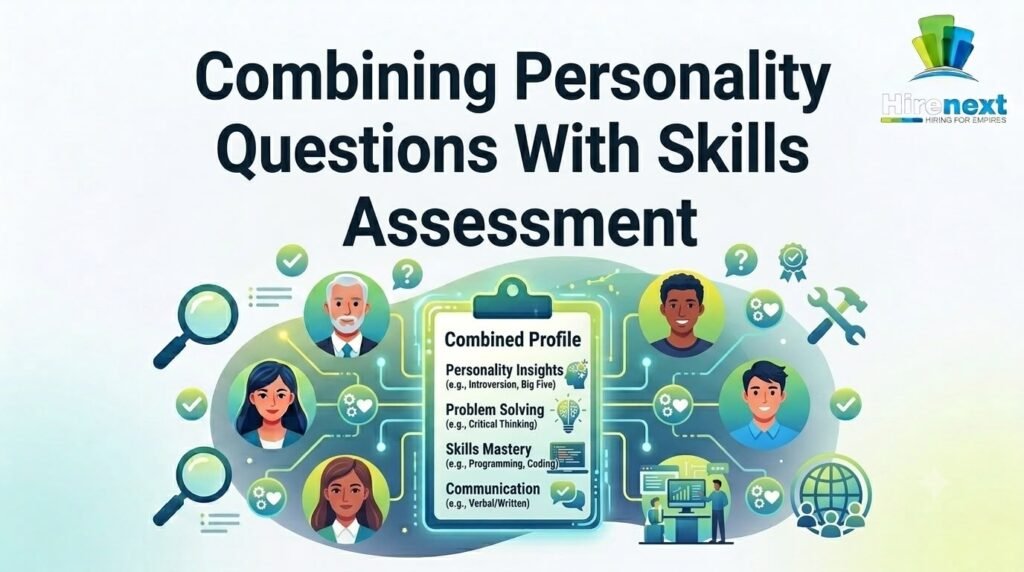
Personality alone should never determine whether someone gets hired.
A strong recruitment process combines personality evaluation with job-related skills.
For example, a marketing candidate might go through:
- Resume screening
- Portfolio review
- Marketing task
- Technical discussion
- Behavioral interview
- Reference check
This creates a broader soft skills assessment while also evaluating practical ability.
The same principle can apply to sales, HR, finance, technology, customer service, and other roles.
The objective is to answer three questions:
Can the candidate do the job?
Will they work effectively with others?
Are they likely to succeed in this particular work environment?
Using multiple evaluation methods makes the final hiring decision more reliable interview questions to assess personality.
Creating a Better Hiring Process
Personality-focused interviews should be part of a structured hiring process rather than an isolated activity.
Companies can create a simple framework:
Step 1: Define Success
Identify the behaviors required for the position.
Step 2: Create Behavioral Questions
Develop questions connected to those behaviors.
Step 3: Build a Scoring System
Rate answers using consistent criteria.
Step 4: Train Interviewers
Ensure interviewers understand how to evaluate evidence objectively.
Step 5: Combine Interview Results
Review behavioral answers alongside technical and practical assessments.
Step 6: Document Decisions
Record job-related reasons for hiring or rejecting candidates.
This approach makes interview questions to assess personality more useful, consistent, and fair.
Conclusion
Finding the right candidate requires more than reviewing qualifications and asking standard interview questions.
Candidates may have similar degrees, certifications, and technical experience while demonstrating very different approaches to teamwork, accountability, pressure, feedback, and change.
That is why interview questions to assess personality can play an important role in modern recruitment.
Questions about mistakes, criticism, conflict, pressure, adaptability, unfamiliar tasks, and initiative can reveal valuable information about how candidates have behaved in real situations.
However, recruiters should not try to judge a person’s entire personality during a single interview. Instead, they should focus on job-relevant behaviors and use structured behavioral questions to ask candidates.
A strong soft skills assessment should be combined with technical evaluation, work samples, reference checks, and other hiring methods.
The goal isn’t to find candidates who give perfect answers.
The goal is to identify candidates who demonstrate accountability, adaptability, communication, resilience, initiative, and a willingness to learn.
When recruiters ask better questions and evaluate answers objectively, they can make more informed hiring decisions and build stronger teams.
Ultimately, the best interview is not the one that reveals what candidates say about themselves.
It is the one that helps recruiters understand what candidates have actually done.