
The Biggest Hiring Lie Companies Still Believe
Introduction
Hiring is one of the most important decisions a company makes, yet it is also one of the areas surrounded by the most assumptions and outdated beliefs.
Companies want to hire talented people quickly, build strong teams, and reduce employee turnover. However, many organizations continue to rely on traditional ideas about recruitment that may no longer work in today’s competitive job market.
These beliefs have created several common hiring myths that influence how businesses search for, evaluate, and select candidates.
From believing that the candidate with the most experience is always the best choice to assuming that a longer hiring process automatically produces better employees, these myths can prevent companies from making effective hiring decisions.
One of the biggest hiring myths is that the “perfect candidate” is easy to identify if a company simply creates the right job description and waits for applications to arrive.
In reality, finding the right person requires a strategic approach that considers skills, potential, attitude, communication, adaptability, cultural alignment, and long-term goals.
Understanding the misconceptions about finding the right candidates can help businesses rethink their approach and create a more efficient hiring process.
This article explores some of the most common hiring myths companies still believe and explains what businesses should consider when building stronger teams.
Table of Contents
Introduction
Why Hiring Myths Continue to Influence Businesses
Myth 1: The Best Candidate Has the Most Experience
Myth 2: A Perfect Resume Means a Perfect Employee
Myth 3: Companies Should Always Hire the Cheapest Candidate
Myth 4: More Interview Rounds Mean Better Hiring
Myth 5: The Right Candidate Will Always Find You
Myth 6: Hiring Is Only HR’s Responsibility
Myth 7: Skills Are More Important Than Attitude
Myth 8: A Big Salary Guarantees Better Talent
Myth 9: Cultural Fit Means Hiring People Who Are Similar
Myth 10: The Perfect Candidate Doesn’t Need Training
Myth 11: Fast Hiring Always Leads to Bad Hiring
Myth 12: Slow Hiring Means Better Hiring
Myth 13: Job Portals Are Enough to Find Talent
Myth 14: Candidates Care Only About Salary
Myth 15: One Hiring Strategy Works for Every Role
The Real Misconceptions About Finding the Right Candidates
How Companies Can Improve Their Hiring Process
The Role of Recruitment Agencies
How Data and Technology Are Changing Hiring
Building a Smarter Hiring Strategy
The Biggest Hiring Lie Companies Still Believe
Conclusion
Why Hiring Myths Continue to Influence Businesses
Recruitment has changed significantly over the years, but many companies still follow outdated hiring practices.
Some organizations rely heavily on:
- Resumes
- Degrees
- Years of experience
- Traditional interviews
- Job portals
While these tools can be useful, they do not always provide a complete picture of a candidate.
Modern hiring requires businesses to understand what candidates can actually contribute to an organization.
The problem is that hiring myths can influence decisions without companies realizing it.
For example, a business may reject a talented candidate because they do not have a specific degree, even though they have relevant practical experience.
Another company may spend months searching for someone with ten years of experience when a motivated professional with five years of experience could perform the role effectively.
These misconceptions about finding the right candidates can increase hiring costs and delay business growth.
Myth 1: The Best Candidate Has the Most Experience
One of the most common hiring myths is that experience automatically equals better performance.
Experience is valuable, but it is not the only factor that determines whether someone will succeed.
A candidate with ten years of experience may have developed strong expertise. However, another candidate with five years of experience may have:
- Better adaptability
- Stronger communication
- Greater motivation
- More relevant technical skills
- Better problem-solving abilities
Companies should therefore evaluate the quality and relevance of experience rather than simply counting years.
For example, if a company is hiring a digital marketing professional, five years of experience working with relevant platforms and campaigns may be more valuable than ten years of general marketing experience.
The best hiring process evaluates candidates based on the actual requirements of the role.
Myth 2: A Perfect Resume Means a Perfect Employee
A resume is a useful screening tool, but it cannot predict future performance with complete accuracy.
A polished resume may show:
- Education
- Experience
- Skills
- Certifications
However, it may not reveal:
- Work ethic
- Attitude
- Communication
- Adaptability
- Emotional intelligence
This is why companies should avoid relying entirely on resumes.
A strong hiring strategy combines resume evaluation with:
- Structured interviews
- Skills assessments
- Behavioral questions
- Reference checks
- Practical assignments
One of the biggest hiring myths is believing that the strongest resume automatically belongs to the strongest candidate.
In reality, hiring decisions should consider the complete candidate profile.
Myth 3: Companies Should Always Hire the Cheapest Candidate
Cost is an important consideration for every business.
However, choosing a candidate solely because they demand the lowest salary can create long-term problems.
A low-cost hire may lack essential skills or require extensive training.
Companies should consider the overall value a candidate can provide.
The right question is not:
“Who will cost us the least?”
Instead, businesses should ask:
“Who can deliver the best value for this role?”
A highly skilled employee may have a higher salary expectation but could contribute significantly through:
- Increased productivity
- Better performance
- Faster execution
- Stronger customer relationships
This is another example of hiring myths influencing business decisions.
Myth 4: More Interview Rounds Mean Better Hiring
Some companies believe that adding more interviews automatically improves hiring quality.
However, excessive interview rounds can create problems.
Long hiring processes may:
- Frustrate candidates
- Delay decisions
- Increase candidate drop-offs
- Cause companies to lose top talent
A well-structured hiring process is more valuable than a long one.
Companies should focus on asking meaningful questions and evaluating relevant skills.
The goal should be to gather enough information to make a confident decision—not to create unnecessary delays.
Myth 5: The Right Candidate Will Always Find You
Many companies post a job opening and simply wait for applications.
This approach can limit access to qualified talent.
Not every strong candidate is actively searching for a new job.
Some professionals are passive candidates who may consider an opportunity if the right position is presented to them.
Companies should therefore consider proactive sourcing strategies such as:
- Professional networks
- Employee referrals
- LinkedIn outreach
- Talent databases
- Recruitment agencies
One of the biggest misconceptions about finding the right candidates is assuming that the best people will always apply themselves.
Sometimes, companies need to actively search for the talent they need.
Myth 6: Hiring Is Only HR’s Responsibility
HR plays an important role in recruitment, but hiring should not be the responsibility of HR alone.
Successful hiring requires collaboration between:
- HR professionals
- Hiring managers
- Team leaders
- Department heads
- Business leadership
HR may understand recruitment processes, while hiring managers understand the technical requirements of the role.
Combining these perspectives can improve hiring decisions.
When hiring becomes a shared responsibility, companies can create a more effective hiring process.
Myth 7: Skills Are More Important Than Attitude
Technical skills are essential, but attitude can significantly influence long-term performance.
A candidate may have excellent technical knowledge but struggle with:
- Teamwork
- Feedback
- Accountability
- Adaptability
Meanwhile, another candidate may have slightly fewer technical skills but demonstrate:
- Strong motivation
- Curiosity
- Willingness to learn
- Positive communication
This does not mean companies should ignore skills.
Instead, they should evaluate both technical capabilities and professional attitude.
A balanced approach can help organizations identify candidates with long-term potential.
Myth 8: A Big Salary Guarantees Better Talent
Another common belief is that offering a higher salary automatically attracts the best candidates.
Compensation is certainly important, but modern professionals also consider other factors.
Candidates may evaluate:
- Career growth
- Workplace culture
- Flexibility
- Leadership
- Learning opportunities
- Work-life balance
- Job security
A company offering a high salary but poor workplace culture may struggle to retain employees.
The best hiring strategies therefore focus on the complete employee value proposition.
Myth 9: Cultural Fit Means Hiring People Who Are Similar
One of the more complicated hiring myths is the idea that cultural fit means hiring people who are similar to the existing team.
This can create unconscious bias.
For example, hiring managers may prefer candidates who:
- Have similar backgrounds
- Share similar interests
- Communicate in the same way
- Attended similar schools
However, effective cultural fit should focus on shared professional values rather than personal similarities.
Companies should look for candidates who respect the organization’s values while bringing new perspectives and experiences.
A diverse workforce can contribute to:
- Innovation
- Better decision-making
- Creative problem-solving
- Different perspectives
Therefore, companies should avoid turning cultural fit into a reason for hiring people who simply “fit in.”
Myth 10: The Perfect Candidate Doesn’t Need Training
Another common hiring myth is that the ideal employee should be able to perform perfectly from day one.
In reality, every organization has unique:
- Processes
- Systems
- Policies
- Tools
- Workflows
Even highly experienced professionals need time to understand how a new company operates.
Effective onboarding and training can help employees become productive faster.
Companies should therefore evaluate a candidate’s ability to learn rather than expecting them to know everything immediately.
A candidate with strong learning ability may ultimately outperform someone with more experience but less adaptability.
Myth 11: Fast Hiring Always Leads to Bad Hiring
Speed and quality are not necessarily opposites.
One of the most persistent hiring myths is that companies must choose between hiring quickly and hiring well.
In reality, an efficient hiring process can achieve both.
The key is preparation.
Companies can improve hiring speed by:
- Defining job requirements clearly
- Creating structured interviews
- Establishing decision-making timelines
- Maintaining talent pipelines
- Using recruitment technology
The goal is not to rush hiring decisions.
Instead, companies should eliminate unnecessary delays while maintaining quality standards.
Myth 12: Slow Hiring Means Better Hiring
The opposite belief is equally problematic.
Some companies assume that taking months to hire demonstrates that they are being careful.
However, prolonged hiring processes can result in:
- Candidate frustration
- Offer rejections
- Lost productivity
- Increased workload
- Competitors hiring top talent
A slow hiring process does not automatically produce better results.
The quality of the evaluation matters more than the length of the process.
Companies should focus on making informed decisions within a reasonable timeframe.
Myth 13: Job Portals Are Enough to Find Talent
Job portals are useful recruitment tools, but they should not be the only sourcing method.
Relying entirely on job boards can limit the candidate pool.
Companies should consider multiple channels, including:
- Employee referrals
- Social media
- Professional networks
- Recruitment agencies
- Industry communities
- Talent databases
Different roles require different sourcing strategies.
For example, a company looking for entry-level candidates may benefit from campus recruitment, while a specialized senior role may require direct sourcing.
One of the biggest misconceptions about finding the right candidates is believing that posting a job advertisement is enough.
Myth 14: Candidates Care Only About Salary
Salary is important, but it is rarely the only factor influencing a candidate’s decision.
Today’s professionals may also consider:
- Career growth
- Learning opportunities
- Work flexibility
- Company culture
- Leadership quality
- Recognition
- Job security
A company that understands these expectations can attract and retain better talent.
Recruiters and hiring managers should therefore communicate the complete value of the opportunity rather than focusing exclusively on compensation.
Myth 15: One Hiring Strategy Works for Every Role
Every position has different requirements.
A company hiring a receptionist may prioritize:
- Communication
- Professionalism
- Customer service
A software developer may require:
- Technical expertise
- Problem-solving
- Coding skills
A senior manager may need:
- Leadership
- Strategic thinking
- Decision-making
Using the same hiring process for every role can lead to ineffective recruitment.
Companies should customize their hiring strategy according to:
- Job level
- Industry
- Skills required
- Hiring volume
- Candidate availability
This flexible approach can improve recruitment outcomes.
The Real Misconceptions About Finding the Right Candidates
The biggest misconceptions about finding the right candidates often come from viewing recruitment as a simple transaction.
Hiring is not simply:
Post a job → Receive resumes → Interview candidates → Hire someone.
Modern recruitment is much more complex.
Businesses need to consider:
- Talent availability
- Candidate expectations
- Employer branding
- Skills gaps
- Workplace culture
- Hiring speed
The right candidate is not always the person with the longest resume or the highest qualification.
Instead, the ideal candidate is someone who can meet the requirements of the role, contribute to the team, and grow with the organization.
How Companies Can Improve Their Hiring Process
Businesses can improve their hiring process by moving away from assumptions and focusing on evidence-based recruitment.
Define the Role Clearly
Before beginning recruitment, companies should establish:
- Required skills
- Responsibilities
- Experience level
- Salary range
- Performance expectations
Clear requirements make candidate evaluation easier.
Use Structured Interviews
Structured interviews ensure candidates are evaluated against consistent criteria.
This can reduce bias and improve decision-making.
Assess Skills Practically
Where possible, companies should use practical assessments.
For example:
- Writing tests
- Technical assignments
- Case studies
- Role-play exercises
These methods can reveal capabilities that resumes cannot.
Improve Candidate Communication
Candidates should receive timely updates throughout the hiring process.
Clear communication improves trust and creates a better candidate experience.
Track Recruitment Metrics
Businesses can monitor:
- Time to hire
- Cost per hire
- Offer acceptance rate
- Employee retention
- Quality of hire
Data can help organizations identify weaknesses in their recruitment strategy.
The Role of Recruitment Agencies
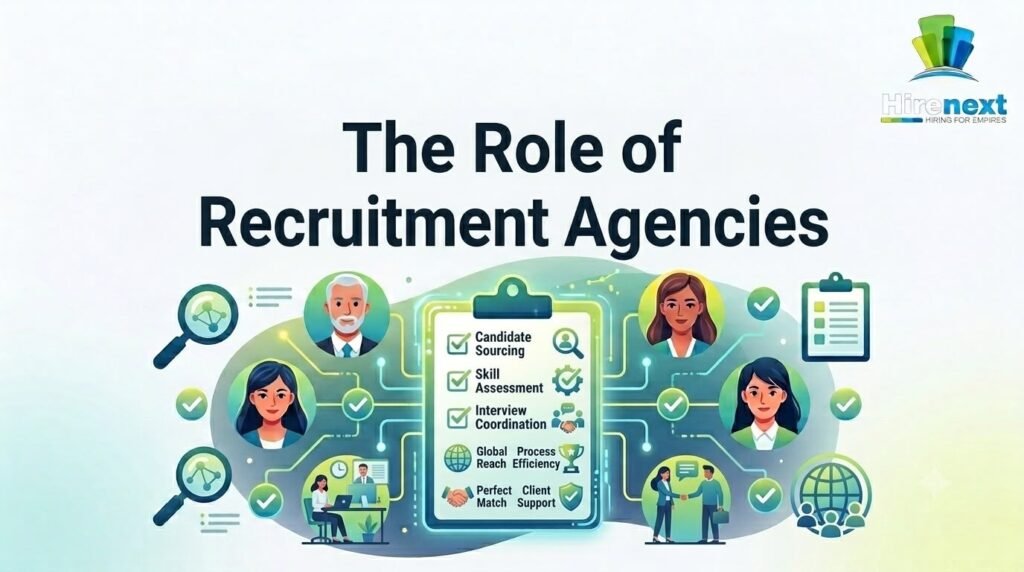
Recruitment agencies can help businesses overcome many common hiring myths and recruitment challenges.
Professional recruiters understand:
- Candidate sourcing
- Talent markets
- Resume screening
- Candidate evaluation
- Salary expectations
They can also help companies access candidates who may not actively apply to job advertisements.
Recruitment agencies can be particularly useful for:
- Urgent hiring
- Specialized roles
- Bulk recruitment
- Difficult-to-fill positions
By providing external expertise, recruitment agencies can support companies in creating a more efficient hiring process.
How Data and Technology Are Changing Hiring
Technology is transforming recruitment.
Modern organizations increasingly use:
- Applicant tracking systems
- AI-powered screening
- Recruitment analytics
- Automated interview scheduling
- Digital assessments
These tools can reduce administrative workloads and help recruiters manage large numbers of applications.
However, technology should support human decision-making rather than completely replace it.
Recruitment is ultimately about people.
Human judgment remains important when evaluating:
- Communication
- Motivation
- Cultural alignment
- Career goals
The best hiring strategies combine technology with human expertise.
Building a Smarter Hiring Strategy
Companies can build stronger recruitment strategies by focusing on five principles.
1. Hire for Potential
Do not focus exclusively on past experience.
Consider a candidate’s ability to learn and grow.
2. Focus on Skills
Evaluate what candidates can actually do.
3. Improve Hiring Speed
Remove unnecessary delays from the recruitment process.
4. Expand Talent Sources
Do not depend on a single recruitment channel.
5. Continuously Improve
Use recruitment data to identify what works and what does not.
These practices can help organizations move beyond outdated hiring myths.
The Biggest Hiring Lie Companies Still Believe
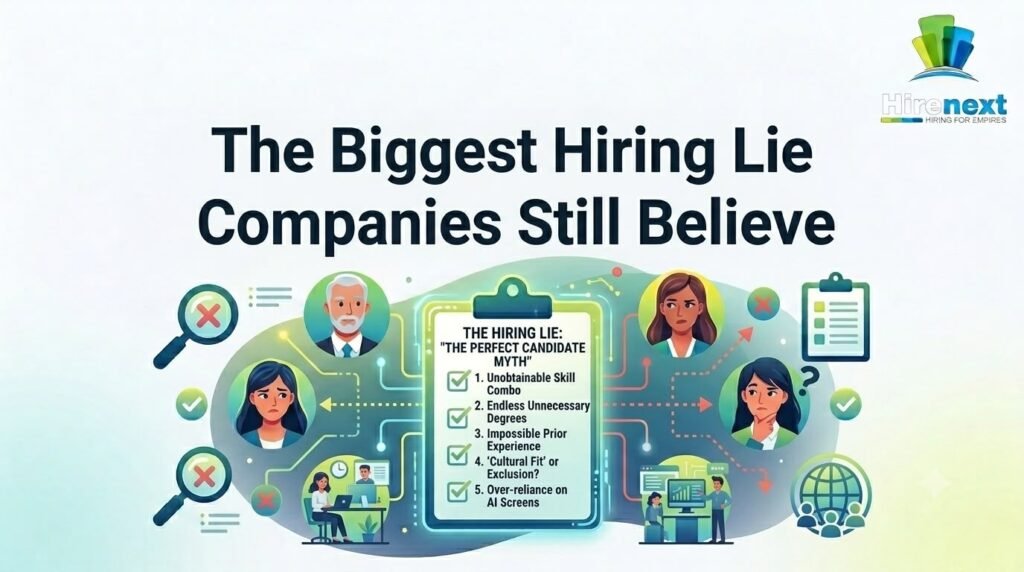
So, what is the biggest hiring lie?
It is the belief that there is one perfect formula for finding the perfect employee.
There isn’t.
Every company, role, and candidate is different.
Successful recruitment requires flexibility, thoughtful evaluation, and a willingness to challenge assumptions.
The best organizations understand that hiring is not about finding someone who looks perfect on paper.
It is about finding someone who can perform the role, contribute to the team, adapt to change, and grow with the business.
Conclusion
The recruitment landscape has changed, but many companies continue to rely on outdated hiring myths.
Believing that experience always beats potential, that the best candidate has the perfect resume, or that longer hiring processes produce better employees can lead to poor recruitment decisions.
The misconceptions about finding the right candidates can also prevent companies from exploring new talent sources and considering candidates with different backgrounds and experiences.
A successful hiring process should focus on skills, potential, communication, adaptability, cultural alignment, and long-term value.
Companies should also understand that hiring speed and hiring quality do not have to be opposites. With structured interviews, clear job requirements, practical assessments, technology, and professional recruitment support, businesses can make better decisions without unnecessary delays.
Ultimately, the biggest hiring mistake is believing that recruitment can be solved with one simple formula.
The companies that succeed in attracting great talent are those willing to challenge traditional hiring myths, understand changing candidate expectations, and continuously improve how they find and evaluate people.
Because the right candidate is not always the most experienced, the cheapest, or the one with the most impressive resume.
Sometimes, the right candidate is the person a company would have missed if it had continued believing the same old hiring myths.