
Hiring Checklist Every Business Owner Should Follow
Hiring the right employee can have a major impact on a business. A strong hire can improve productivity, strengthen the team, serve customers better, and contribute to long-term growth. On the other hand, a poor hiring decision can lead to lost time, additional costs, low morale, and repeated recruitment efforts.
For business owners, having a structured hiring checklist can make recruitment more organized, consistent, and efficient. Instead of making decisions based only on instinct, employers can follow a clear process that covers everything from defining the position and sourcing candidates to interviews, background verification, job offers, and onboarding.
A hiring checklist is especially useful for small businesses and growing companies where owners or managers may personally handle recruitment. It helps ensure that important steps are not forgotten and that every candidate is evaluated against the same requirements.
This guide explains a practical step by step hiring process for businesses, including what employers should do before, during, and after hiring.
Table of Contents
- Why Every Business Needs a Hiring Checklist
- Define the Job Role Clearly
- Create an Accurate Job Description
- Set the Hiring Budget
- Define Candidate Requirements
- Choose the Right Recruitment Channels
- Build a Candidate Pool
- Screen Resumes and Applications
- Conduct the Initial Screening
- Prepare Structured Interview Questions
- Evaluate Technical and Soft Skills
- Check Cultural and Role Fit
- Conduct Background Verification
- Check References
- Compare Candidates Objectively
- Make the Final Hiring Decision
- Prepare and Send the Job Offer
- Complete Pre-Employment Documentation
- Prepare for Employee Onboarding
- Common Hiring Mistakes to Avoid
- Final Hiring Checklist for Business Owners
- Conclusion
Why Every Business Needs a Hiring Checklist
Recruitment can become complicated when there is no defined process.
Business owners may receive dozens or hundreds of applications, interview multiple people, negotiate salaries, verify information, and coordinate joining dates. Without a system, important details can easily be overlooked.
A detailed hiring checklist creates a repeatable process.
It can help businesses:
- Save recruitment time
- Improve candidate quality
- Reduce hiring mistakes
- Maintain consistent evaluations
- Improve candidate experience
- Reduce unnecessary recruitment costs
- Keep hiring documentation organized
- Make better hiring decisions
A hiring checklist does not need to be complicated. Even a simple document containing the key stages can make recruitment significantly easier.
1. Define the Job Role Clearly
The first step in any hiring checklist should be defining exactly why the business needs to hire.
Before publishing a job opening, ask:
- Why is this position necessary?
- Is it a new role or replacement?
- What responsibilities will the employee handle?
- Who will they report to?
- What results are expected?
- Is the role full-time, part-time, contractual, or temporary?
A clearly defined role makes every later stage of the hiring process easier.
For example, hiring for a “Digital Marketing Executive” is too broad if the company does not define whether the person will manage SEO, paid advertising, social media, content, analytics, or all of these responsibilities.
A good hiring checklist should therefore begin with a specific business need.
2. Create an Accurate Job Description
Once the role is defined, create a job description that accurately reflects the position.
Include:
- Job title
- Department
- Location
- Work arrangement
- Responsibilities
- Required qualifications
- Required experience
- Technical skills
- Soft skills
- Salary range, where appropriate
- Working hours
- Benefits
- Reporting structure
Avoid adding unrealistic requirements simply to make the job posting appear more impressive.
A clear job description helps attract relevant candidates and reduces applications from people who aren’t suitable for the position.
It is one of the most important steps in a practical hiring checklist.
3. Set the Hiring Budget
Hiring costs more than an employee’s salary.
Business owners should consider:
- Salary
- Recruitment fees
- Job posting costs
- Advertising costs
- Interview time
- Background verification
- Equipment
- Training
- Benefits
- Onboarding expenses
Before starting recruitment, determine the maximum compensation and overall hiring budget.
A defined budget also helps employers negotiate realistically and avoid wasting time with candidates whose expectations are far outside the company’s range.
4. Define Candidate Requirements
Not every requirement should have the same importance.
Divide candidate requirements into three categories:
Must-Have Skills
These are essential for performing the job.
Preferred Skills
These are useful but can potentially be learned.
Behavioral Qualities
These include communication, adaptability, teamwork, accountability, initiative, and problem-solving.
This distinction is useful because businesses sometimes reject capable candidates for lacking a preferred qualification while overlooking their actual ability to perform the job.
A good hiring checklist should encourage employers to evaluate skills based on their importance to the position.
5. Choose the Right Recruitment Channels
The next stage of the hiring checklist is deciding where to find candidates.
Businesses can use:
- Job portals
- Social media
- Employee referrals
- Recruitment agencies
- Professional communities
- Industry groups
- College or university networks
- Company career pages
The best recruitment channel depends on the role.
For example, specialized technical positions may require professional communities and targeted sourcing, while local operational roles may perform better through regional job portals and referrals.
Using the right channel can improve both candidate quality and recruitment speed.
6. Build a Candidate Pool
Don’t immediately interview every applicant.
First, create a candidate pool based on the job requirements.
A strong candidate pool should contain people who meet the essential requirements and appear capable of succeeding in the role.
During this stage, businesses should avoid judging candidates based on irrelevant factors.
The goal is to identify potential matches, not find a reason to reject every applicant.
7. Screen Resumes and Applications
Resume screening is one of the most time-consuming parts of recruitment.
Use consistent criteria to evaluate applicants.
Check:
- Relevant experience
- Required skills
- Career progression
- Education where relevant
- Portfolio or work samples
- Employment gaps where appropriate
- Job stability
- Role-specific achievements
Avoid spending too much time on candidates who clearly don’t meet the essential requirements.
Using an applicant tracking system can also make this stage easier for companies handling high application volumes.
8. Conduct the Initial Screening
An initial phone or video screening can save time before a full interview.
The recruiter can confirm:
- Current employment status
- Relevant experience
- Salary expectations
- Location
- Notice period
- Availability
- Interest in the position
This stage can also help identify whether the candidate understands the role.
A short screening call can prevent both employers and candidates from spending time on a full interview when basic requirements don’t match.
9. Prepare Structured Interview Questions
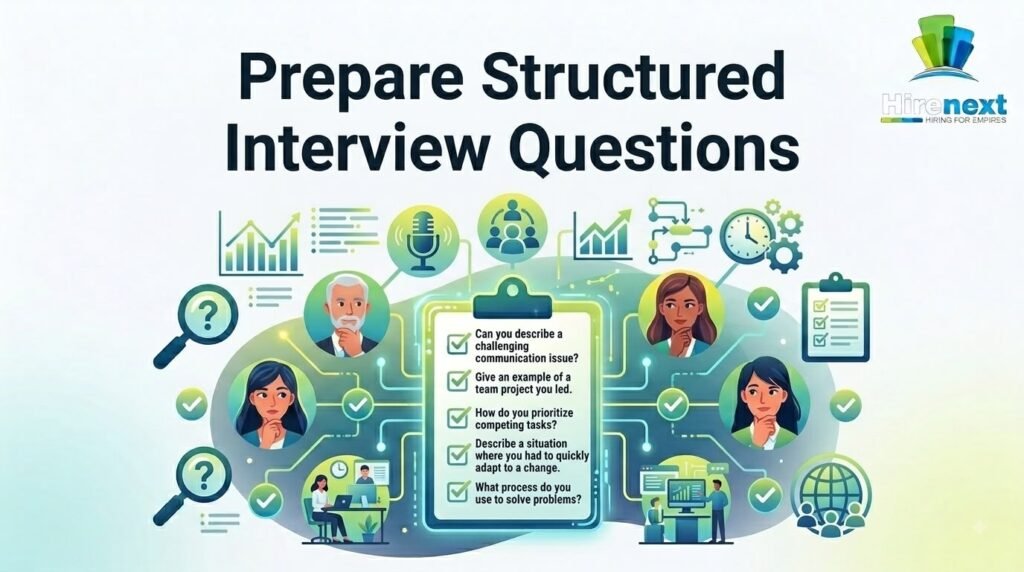
A strong hiring checklist should include interview preparation.
Avoid conducting every interview casually.
Prepare questions related to:
- Technical knowledge
- Previous experience
- Problem-solving
- Communication
- Teamwork
- Adaptability
- Decision-making
- Role-specific situations
Behavioral questions can be particularly useful.
For example:
“Tell me about a time you had to solve a difficult problem at work. What did you do?”
This provides more useful information than simply asking:
“Are you a good problem solver?”
10. Evaluate Technical and Soft Skills
A candidate’s resume doesn’t always demonstrate what they can actually do.
Depending on the role, businesses can use:
- Technical tests
- Writing assignments
- Case studies
- Portfolio reviews
- Sales simulations
- Coding tests
- Practical tasks
- Role-play exercises
Soft skills should also be evaluated.
Important qualities may include:
- Communication
- Teamwork
- Accountability
- Adaptability
- Time management
- Emotional intelligence
- Initiative
A comprehensive hiring checklist should evaluate both capability and behavior.
11. Check Cultural and Role Fit
Culture fit should not mean hiring people who are similar to the existing team.
Instead, evaluate whether the candidate’s working style and values align with genuine job requirements.
Consider:
- Communication style
- Collaboration
- Attitude toward feedback
- Work preferences
- Approach to responsibility
- Adaptability
- Professional values
Businesses should also remember that diversity of experience and perspective can strengthen teams.
12. Conduct Background Verification
Background verification can be an important part of recruitment, particularly for roles involving sensitive information, finances, customers, or significant responsibility.
Depending on the position and applicable laws and policies, verification may involve checking:
- Employment history
- Educational qualifications
- Professional credentials
- References
- Identity information
- Other role-relevant information
Businesses should obtain appropriate consent and follow applicable privacy, employment, and legal requirements.
The objective isn’t to investigate candidates unnecessarily. It is to verify relevant information and reduce avoidable hiring risks.
A hiring checklist should clearly specify what verification is required for each position.
13. Check References
Reference checks can provide additional context about a candidate’s previous work.
Ask job-related questions such as:
- What was the candidate’s role?
- What responsibilities did they handle?
- What were their strengths?
- How did they work with others?
- How did they respond to feedback?
- Would you rehire them?
Reference checks should be consistent and focused on information relevant to the position.
They should complement, rather than replace, the company’s own evaluation.
14. Compare Candidates Objectively
Once interviews, assessments, and verification are completed, compare candidates using a consistent framework.
Create a simple scorecard based on:
| Evaluation Area | Suggested Weight |
|---|---|
| Technical Skills | 25% |
| Relevant Experience | 20% |
| Problem-Solving | 15% |
| Communication | 10% |
| Teamwork | 10% |
| Adaptability | 10% |
| Role-Specific Requirements | 10% |
The exact weighting should depend on the position.
A sales role may prioritize communication and persuasion, while a technical role may give greater weight to technical skills and problem-solving.
A scorecard makes the hiring checklist more objective.
15. Make the Final Hiring Decision
Before selecting a candidate, review all available evidence.
Ask:
- Does the candidate meet the essential requirements?
- Can they perform the core responsibilities?
- Did they demonstrate relevant skills?
- Did they perform well during assessments?
- Did references support their claims?
- Was background verification satisfactory?
- Are compensation expectations realistic?
- Can the business support their growth?
Avoid making a decision solely because you “liked” one candidate more.
A good hiring decision should be supported by evidence.
16. Prepare and Send the Job Offer
Once the decision is finalized, prepare a clear offer.
The offer should clearly communicate relevant terms such as:
- Job title
- Compensation
- Start date
- Work location
- Working hours
- Reporting manager
- Benefits
- Employment conditions
- Probation terms, if applicable
- Other applicable terms
Make sure the offer is consistent with what was discussed during the recruitment process.
Clear communication at this stage helps prevent misunderstandings.
17. Complete Pre-Employment Documentation
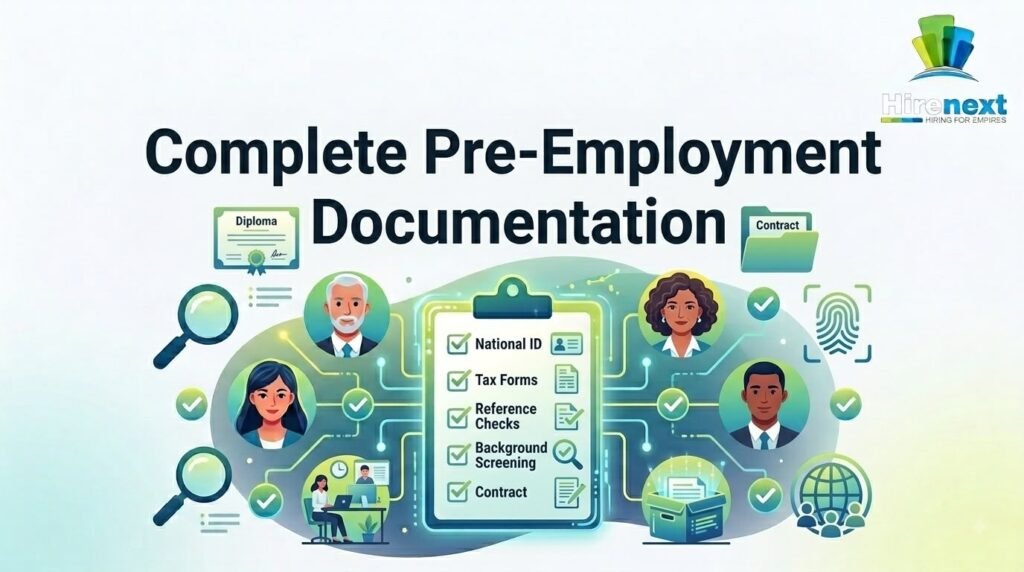
Before the employee joins, collect necessary documentation according to the organization’s requirements and applicable law.
Depending on the role and location, this may include:
- Identity documentation
- Address information
- Tax-related documentation
- Bank details
- Educational records
- Employment documentation
- Signed agreements
Businesses should collect only information that is necessary and handle employee data securely.
18. Prepare for Employee Onboarding
Hiring doesn’t end when the candidate accepts the offer.
A successful hiring checklist should continue into onboarding.
Before the employee’s first day, prepare:
- Workspace
- Laptop or equipment
- Email account
- Software access
- ID or access cards
- Team introductions
- Training schedule
- Job expectations
- First-week goals
Good onboarding helps employees become productive faster and feel more comfortable in their new environment.
19. Common Hiring Mistakes to Avoid
Even businesses with a hiring system can make mistakes.
Hiring Too Quickly
Speed is useful, but rushing can cause employers to overlook important information.
Relying Only on Resumes
Resumes show experience but don’t necessarily prove practical ability.
Ignoring Soft Skills
Communication and adaptability can strongly influence workplace performance.
Skipping Background Verification
For roles where verification is appropriate, skipping it can create unnecessary risks.
Using Unstructured Interviews
Different questions for every candidate make comparisons difficult.
Hiring Based on Personal Preference
Recruiters should evaluate job-related evidence rather than personality similarity.
Poor Candidate Communication
Long periods without updates can damage candidate experience and employer reputation.
Weak Onboarding
A successful hire can still struggle if they receive little guidance after joining.
20. Final Hiring Checklist for Business Owners
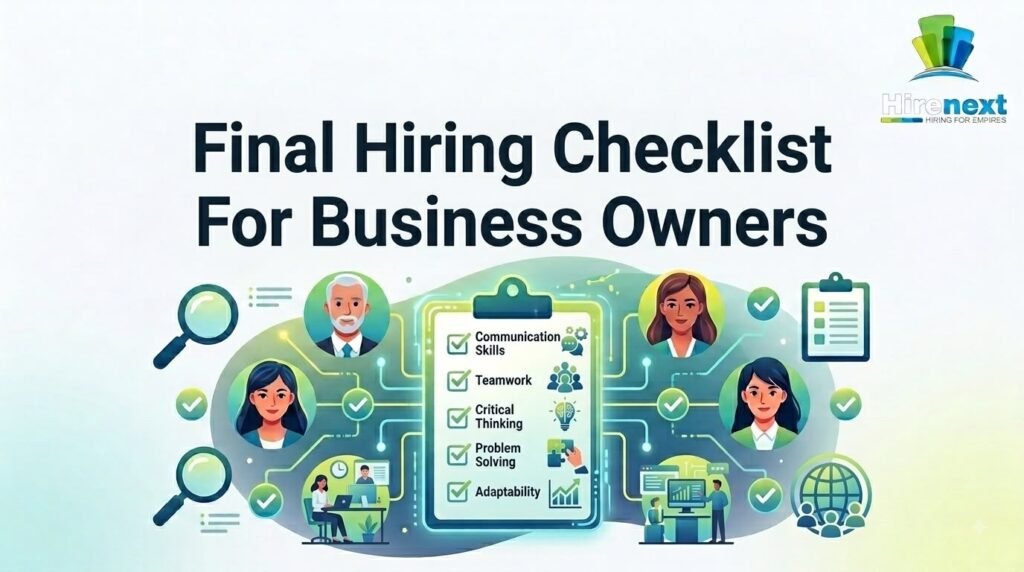
Business owners can use the following list before finalizing a hire.
Before Recruitment
☐ Define the business need
☐ Create the job description
☐ Set the hiring budget
☐ Define essential skills
☐ Define preferred skills
☐ Determine compensation range
☐ Select recruitment channels
Candidate Sourcing
☐ Publish the job
☐ Source candidates proactively
☐ Build a candidate pool
☐ Screen applications
☐ Conduct initial screening
Interviews
☐ Prepare structured questions
☐ Evaluate technical skills
☐ Evaluate soft skills
☐ Assess relevant experience
☐ Conduct practical assessments where necessary
☐ Record interview feedback
Verification
☐ Conduct appropriate background verification
☐ Verify relevant credentials
☐ Complete reference checks
☐ Review all candidate information
Final Decision
☐ Compare candidates objectively
☐ Review assessment results
☐ Confirm compensation
☐ Select the strongest candidate
☐ Document the hiring decision
Offer and Onboarding
☐ Prepare the offer
☐ Communicate employment terms
☐ Collect required documentation
☐ Prepare equipment and access
☐ Assign onboarding responsibilities
☐ Set first-week expectations
☐ Schedule follow-up discussions
This hiring checklist can be customized according to the size, industry, location, and hiring requirements of each business.
How to Make the Hiring Process More Efficient
Following a hiring checklist is useful, but businesses can improve efficiency further by creating standardized recruitment systems.
For example, companies can create templates for:
- Job descriptions
- Screening questions
- Interview scorecards
- Candidate emails
- Assessment forms
- Reference checks
- Offer letters
- Onboarding plans
Recruitment technology can also automate repetitive administrative tasks.
Applicant tracking systems can help organize candidates, while scheduling tools can reduce back-and-forth communication.
For businesses with frequent hiring requirements, working with recruitment specialists can also reduce the workload on business owners and internal teams.
The objective is not to make recruitment impersonal.
It is to remove repetitive work so recruiters and managers can spend more time evaluating candidates and making thoughtful decisions.
When Should a Business Use a Recruitment Agency?
Small businesses may not have dedicated recruiters.
In such cases, recruitment agencies can support businesses with activities such as:
- Candidate sourcing
- Resume screening
- Initial interviews
- Candidate shortlisting
- Interview coordination
- Recruitment administration
This can be particularly helpful when a business needs to fill several roles quickly or requires specialized talent.
However, businesses should still maintain clear hiring criteria.
A recruitment partner works best when the company can clearly communicate the position, required skills, compensation, culture, and expectations.
Why a Structured Hiring Process Matters
A structured step by step hiring process for businesses creates consistency.
Without a defined process, one manager may prioritize experience while another prioritizes communication. One interviewer may ask detailed questions while another conducts a casual conversation.
This can create inconsistent hiring decisions.
A structured process gives everyone a common framework.
It can also improve candidate experience because applicants know what to expect at each stage.
The result is a recruitment process that is easier to manage, measure, and improve.
Measuring Hiring Success
A hiring checklist should not only help businesses complete recruitment. It should also help them improve future hiring.
Businesses can track metrics such as:
Time to Hire
How long does it take to fill a position?
Cost per Hire
How much does recruitment cost?
Source of Hire
Which recruitment channel produces the strongest candidates?
Offer Acceptance Rate
How many selected candidates accept offers?
Quality of Hire
How well do new employees perform after joining?
Early Turnover
How many new employees leave within the first few months?
These metrics can reveal where the recruitment process needs improvement.
Conclusion
Hiring is one of the most important responsibilities a business owner can manage, but it doesn’t need to become an unstructured or overwhelming process.
A practical hiring checklist gives businesses a clear framework for moving from identifying a hiring need to successfully onboarding a new employee.
The process should begin by defining the role, creating an accurate job description, setting a budget, and identifying essential skills. From there, businesses can source candidates, screen applications, conduct structured interviews, assess technical and soft skills, complete appropriate background verification, check references, and compare candidates objectively.
The final stages are equally important. A clear job offer, proper documentation, and organized onboarding can determine how successfully a new employee transitions into the organization.
The best step by step hiring process for businesses is one that is structured but flexible enough to adapt to different roles and circumstances.
Most importantly, businesses should remember that hiring isn’t simply about filling a vacancy.
It is about finding someone who can contribute to the organization’s goals, work effectively with the team, and grow with the business.
By following a consistent hiring checklist, using objective evaluation methods, and continuously measuring recruitment outcomes, business owners can reduce hiring mistakes and build stronger, more productive teams.